The Secret Language of Comics: Visual Thinking and Writing

Reflection on Tracing Stitches and Spinning

Considering myself an insightful observer, I was at first pretty confident with my ability to “decode” all the patterns and underlying meanings in the two pages I chose even before the tracing process. However, I was proved wrong when I picked up my pen. When tracing, I noticed that although Stitches was monochrome, I had to carefully address the shading by stressing David’s eye sockets and nose with dark gray color while applying a lighter gray elsewhere. In contrast, I just needed to simply trace out the contour of the characters in Spinning without applying any shading. This distinction inspired me to explore how these different styles relate to the themes of the two texts, which later became the focus of my analysis.

I used to always think about the thesis of my essays before I start writing. For this assignment, though, I forced myself to jump right into the analyzing process built upon my annotations without worrying about what conclusion I was going to end up with. It turned out that I had a pretty hard time structuring my final paragraph because the former two paragraphs seemed to have nothing in common that I struggled to come up with a thesis that spoke for both. Surprisingly, I managed to not only identify the connection between them, but also arrive at an entirely new understanding of the different rhetorical situations two authors are in. If I had started writing with a fixed thesis at hand, I probably wouldn’t get to the exciting conclusion that I have right now.

This assignment definitely helped me explore more about the underlying meanings hidden within the visual elements in Stitches and Spinning. By looking over and over again at the two pages, I realized everything that appears in comics is an artistic choice that reflects the author’s thoughts. Small chose to make his panels distinctive since Stitches has a clear overarching theme of showing David’s trauma, whereas the images in Spinning are more ambiguous and require closer examination because Walden herself was trying to explore who she truly is and what the book is about while making the narration.

Treeccoli

Treeccoli by Joyce Xu

While having lunch today, I began to feel a little bored, so I started to stare at the food on my plate in a daze. Suddenly, I saw the broccoli on my fork, and it reminded me of a miniature tree. With this week’s sketch assignment in mind, I decided to combine the upper part of broccoli and the trunk of a tree to form a whole picture. 

I started by searching up pictures of broccoli and trees on Google, and I experimented by putting them together. However, the original background of the broccoli picture was white, and thus it didn’t match the blue sky background in the tree photo. Therefore, for the first time in my life, I tried to use Snapseed, a photo editing app, to manually add a blue sky background for the broccoli picture. Although the edited image seems a little fake in general, it does create a better transition between the two pictures.


Copyright: https://www.gimmesomeoven.com/how-to-cut-broccoli/

SHUTTERSTOCK
Copyright: https://www.readersdigest.ca/travel/world/beautiful-trees-photos/6/

The final picture surprised me initially because I never thought a tree and broccoli would go so well together. Sometimes when I see the small version of the combo photo on my desktop, I mistake it as a real tree growing vibrantly in the wild. I think the fact that the broccoli in itself is green and luxuriant adds a quality of vitality to the tree. Also, considering that the tiny broccoli which can easily be fit into my mouth is now as “large” as the canopy of a tree is amazingly peculiar and striking.

Visual Notes Taking

Visual Notes for Art History

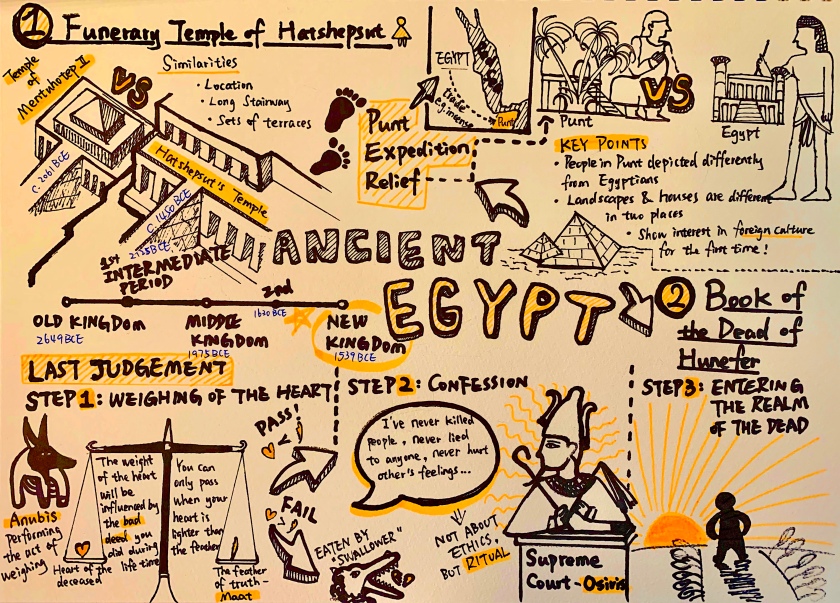
For this week’s Sunday Sketch assignment, I recreated my written notes for an Art History lecture as visual notes.

I started out writing the topic “Ancient Egypt” in the center of the page because all the artworks we learned in class were created during this period. I always struggle with memorizing the chronological order of art periods, so this time, I drew a timeline that laid out major art periods during the Egyptian era so it was easier for me to memorize. Also, I highlighted the “New Kingdom” period in the timeline to indicate the focus of this note.

On top of that, visual notes also made comparisons more straightforward. For example, I couldn’t understand the similarities between the Temple of Hatshepsut and Temple of Mentuhotep II when I looked at my original notes. However, drawing the two temples right next to each other gave me a clearer insight into their similarities, and the same goes for the comparison between Punt and Egyptian culture in the upper right corner of the note.

I personally think that images do a better job of connecting things than texts do. When I was creating my visual notes for The Last Judgement from Book of the Dead, I surprisingly found that images and arrows displayed the separate steps of entering the afterlife in a much more logical way than a bunch of texts could ever achieve. Thus, I no longer have a hard time recalling the exact words from my notes but instead describing the artwork using my own words with the visual image in my mind.

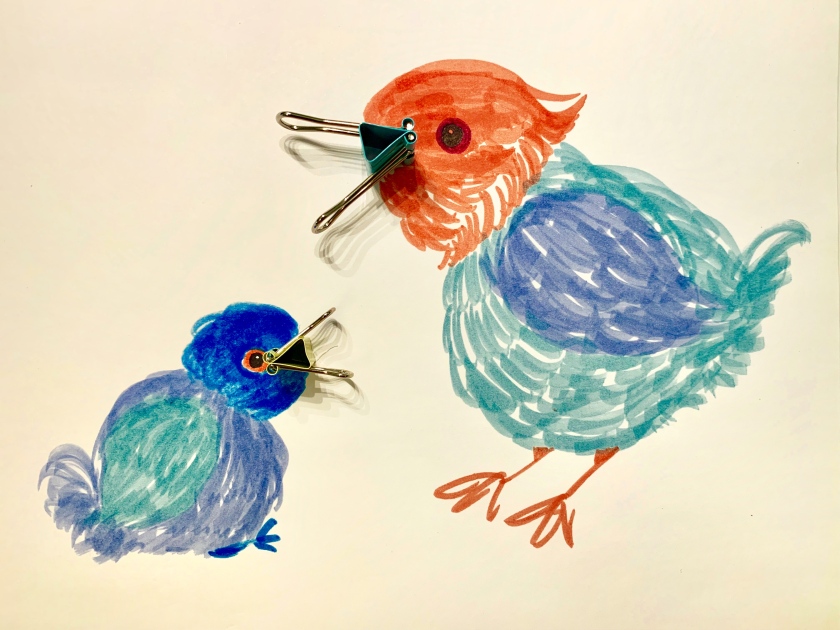
But Mom … I’m Hungry!

But Mom…I’m Hungry! by Joyce Xu

What’s on their beaks? Binder Clips!

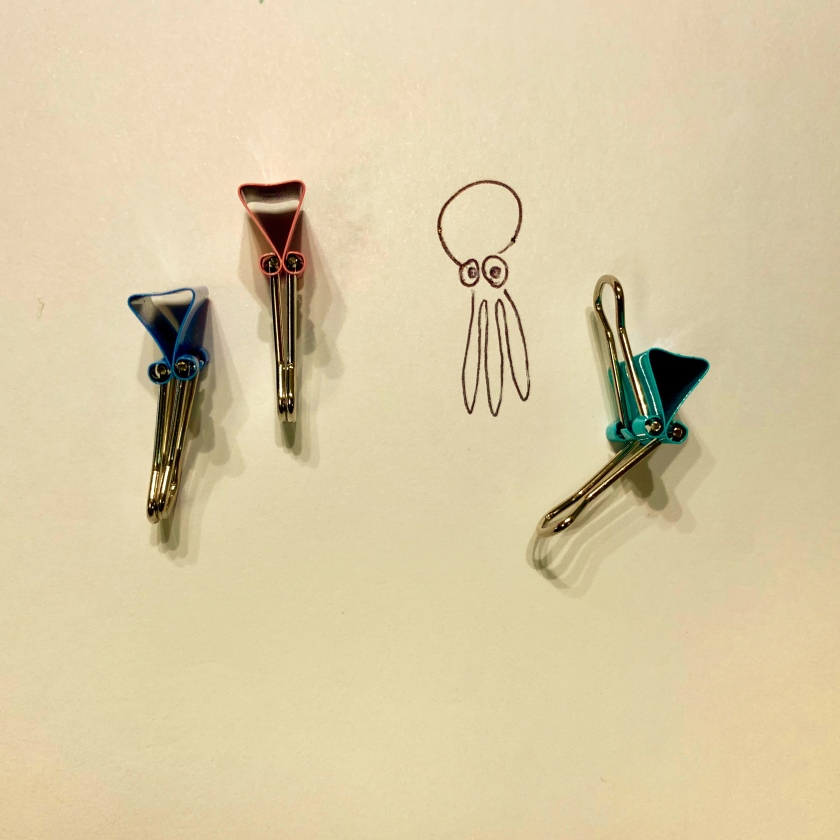
I liked to play with binder clips when I was little. I would bend them into every shape possible and imagined them as dancing octopuses (see below).

Dancing Octopuses by Joyce Xu

Thus, as soon as I saw this assignment, binder clip was the first thing that popped out in my mind. However, since there were so many shapes that binder clips could turn into, it took me a long time to decide how exactly to utilize them in my work.

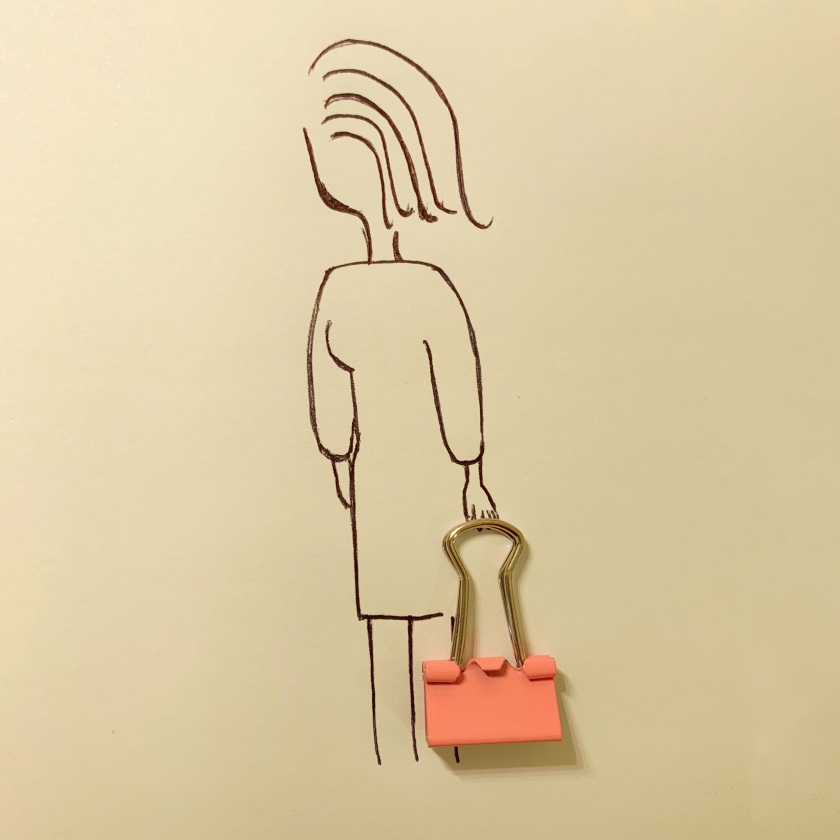
My first idea was portraying them as handbags. Then I realized that I was not that good at drawing figures and most importantly, I wanted to add a sense of movement and interaction to the sketch.

Binder Clip as Handbag by Joyce Xu

When I was experimenting binder clips with different elements, I heard some birds singing outside my window. Watching the clips in my hand, I suddenly came up with the idea of turning them into the beaks of the birds! I first drew the big bird and it turned out very well, but it looked lonely staying on the paper by herself. Therefore, I added another little bird by her side so that the picture was more engaging.

Interestingly, the shadow of the clips is also included in the photo. It seems like the birds are talking to one another with their beaks moving. The little blue bird is sitting on the floor looking up to its mother, and it makes me think of how I used to beg my mom for snacks after meals: “But mom, I’m hungry!”

A Reflection Upon “From ‘Creak Creak’ to ‘Swoosh’”


In my narrative, I explore my childhood experience of learning to read using graphic books and how this shaped me as a visual learner. I then move forward along the timeline and explain how reading and writing pure texts stressed me out as a visual learner in middle school and how I became both a better writer and reader afterward. For the high school period, I focused on portraying my experience of publishing articles online and how this experience led to my discovery of the power of combining written words and visual images.

The free writing exercise was definitely very helpful. In the beginning, I was stuck, but after I started writing I could recall more and more details and added them into my final essay. Still, the actual writing process took much longer than I thought. We are asked to reflect on our experiences that shape the way we READ and WRITE, not just either one of them. Therefore, what troubled me the most when writing this essay was how to carry out this “evolution” in a way that neither one of the two elements was missing. I can easily think of a lot of my experiences on this topic, but there are not that many of them that BOTH influence the way I read and write. In the end, I managed to select four of my experiences that touched on both aspects and structured them into three sections divided by different time periods. Instead of simply call them “childhood”, “middle school”, and “high school”, I was inspired by Stitches to incorporate the use of sounds in my essay. Therefore, I gave every period a particular sound that represents my experiences and set them as subtitles which I think will be interesting to read.

I think the most interesting part of my essay is:

“‘Tac tac’
This was the sound of me pressing my delete key.
‘Tac tac’
I was trying to write something new.
‘Tac tac’
I was deleting it again.
I can still recall those late nights when I watched the cursor blinking and ticking on my screen like the countdown of a time bomb.”

This shows my exact feeling when struggling to write an essay, and I bet many people feel the same.

When I look back at my finished essay, I am surprised by how different it is from the original outline I listed. I got this idea that writing is an “ever-changing” process through which the structure, content, wording, and even topic of the essay can be changed millions of times, and there is no perfect essay but only a better one.

https://joyfuljoyce717.wordpress.com/literacy-narrative/

My Avatar

Secret Garden by Joyce Xu

My avatar is a painting I made this weekend. It is a depiction of a dream I had on Friday night. In my dream, it was 3 o’clock in the morning and the city was asleep. I quietly climbed up to the roof of my house with my beloved guitar and played my favorite song – Tears in Heaven by Eric Clapton. I got so immersed in the music and joy and lost track of time until the last light from my neighbor’s window was shut. As I was about to leave, I heard a deafening noise coming out in the distance. I turned around in fear and surprisingly found tens of thousands of gigantic flowers sprouting up beyond the city’s skyline, rising straightly into the air. There were sunflowers, lilies, roses, daisies, and several other flowers that I’ve never seen before. They all had vibrant colors and weird shapes like those in Alice in Wonderland. I looked up at these incredible plants in wordless awe, thinking I must have found the gateway to my very own secret garden. Suddenly, the first sunlight touched my face and I squinted in the sudden bright light. When I opened my eyes again, all the flowers disappeared, leaving the clear sky and the silent city alone.

I chose this painting as my avatar because it reflects who I am in various ways. First of all, painting is my biggest interest, and clear structures and vibrant colors are two distinctive features of my work.

Time Square by Joyce Xu

Also, you must have realized that I like playing guitar too (except that I don’t play guitar on a roof but safely indoor :)).

The city in the painting is my hometown Guangzhou, one major city in China. It is always loud and busy. Streets filled with people and cars. However, it is still a beautiful city, known as “the city of flowers” because of its mild weather. But this is not the only reason why I painted flowers in the back. As a girl born and raised in a big city, I’ve always longed for returning to nature and finding my inner peace there. Recently I read a book called The Moon and Sixpence. Here, the moon stands for the ambitious dreams we all have and sixpence is the modest income we need for survival. It got me thinking how many people would just keep searching for that sixpence on the ground but never look up to the moon until they finally miss it. Looking back to my painting, the flowers here can be interpreted as another form of the “moon”, or dreams so to speak. Therefore, this painting also expresses my wish that we can keep pursuing our dreams rather than letting a “sixpence” block our sight.

Designing this avatar is actually quite hard for me. To begin with, there are so many things about me and I have to select a few of them to represent myself. Then I struggled about how to put these elements together into a tiny badge, but luckily I found a way to. Besides, painting itself is time-consuming, but after all this process is very enjoyable to me.

css.php