The Secret Language of Comics: Visual Thinking and Writing

Sk3: Visual Note Taking; Latin 370

When choosing the topic for my visual note taking assignment I considered what classes have the most complicated material for me to understand. I chose my Latin 370 class because we are reading Cicero’s Catilinarian Orations and sometimes I struggle to grasp all the arguments he is making and all the rhetorical techniques he is utilizing. By including all the historical, political and social context on one page, I was better able to understand the tactics Cicero was using in his speech to the Roman Senate. Since I have an exam coming up this week on this topic, I found this exercise to be a great way to review and remember the greater context of the speech to help me better analyze and translate the individual portions later. Before today I had never studied for latin in a visual medium and I was surprised by how relieving if felt to get everything down on one page that had been floating around in my head. It felt as though I no longer had to worry about remember every thought I had had because now I had them written down and depicted so I would always have a reference to look to.

You can find the description of this assignment here.
Note Doodles

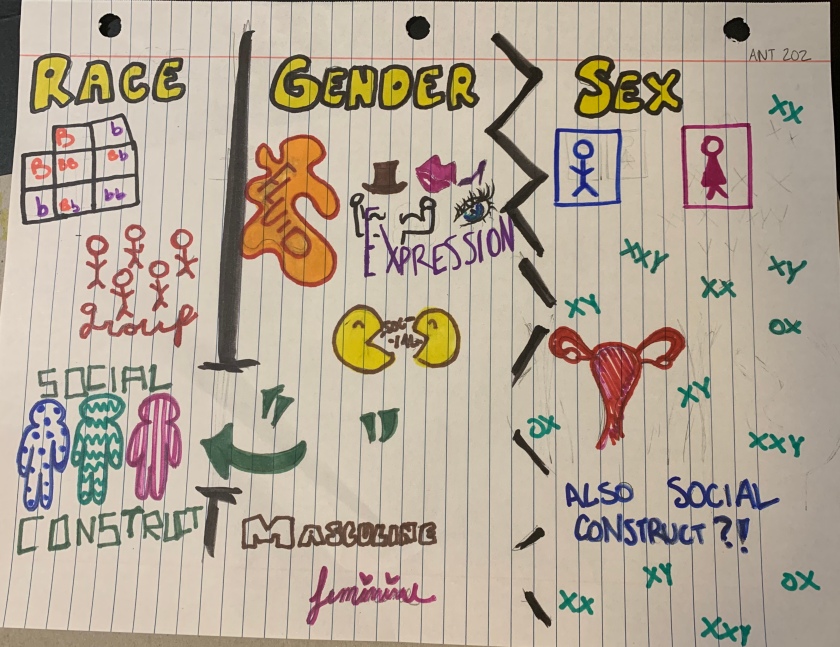
I am enrolled in a Women’s Gender and Sexuality Studies, and these visual notes are not from that class. These notes are actually from the discussion section of my ANT 202 class, also known as Concepts and Methods in Cultural Anthropology. Last Wednesday, all I talked about during my first and last period of the day was race, gender, sex, and everything inbetween. My notes from the discussion period were clear and concise, making them the perfect pick for my visual note taking sketch assignment. I am a natural doodler. Look through my notebooks and you’ll see doodles covering all the margins. When I doodle I listen – the constant movement of my pencil keeps me focused. That being said, I have never drawn anything productive towards the class, it is normally clothing or miscellaneous objects. I am enrolled in a Women’s Gender and Sexuality Studies, and these visual notes are not from that class. These notes are actually from the discussion section of my ANT 202 class, also known as Concepts and Methods in Cultural Anthropology. Last Wednesday, all I talked about during my first and last period of the day was race, gender, sex, and everything in-between. My notes from the discussion period were clear and concise, making them the perfect pick for my visual note-taking sketch assignment. I am a natural doodler. Look through my notebooks and you’ll see doodles covering all the margins. When I doodle I listen – the constant movement of my pencil keeps me focused. That being said, I have never drawn anything productive towards the class, it is normally clothing or miscellaneous objects.

I was nervous to properly portray my notes visually, but once I let go of my Giulia Forsyth-style expectations, the ideas started to flow. Race, gender, and sex were all presented as different categories, race intersects with both gender and sex, and the difference between gender and sex was argued to be negligible (Judith Butler). I wanted to show those intersections and lack of boundaries by creating walls and breaking them. Within each region, I attempted to use as little words as possible and enjoyed playing with color to portray deeper ideas. While I am pleased with the outcome, I know for the future that I would prefer it if my visual notes were connected by a greater theme like a color scheme or a font.

COMPUTER SCIENCE VISUAL NOTE TAKING

CS 170 – Intro to Computer Science. Expressing a dry subject in images was unconventional to me. I believe Computer Science and advanced coding concepts is substantially more complex to be able to be expressed in images. In my Sunday sketch, I decided to show the basic concept of the Java Virtual Machine.

I drew a computer with a large monitor begging to be fed with codes adding a comedic side to my sketch, but I did find it taxing, explaining visually further concepts of coding due to the level of complexity involved, though, learning visually did help me in understanding the basic concept of converting high-level languages to binary code. I found out that thinking visually helps in certain parts or subjects but not in problem solving or mathematical concepts. I found the process of constructing my own Sunday sketch difficult as, in my opinion, Comp Sci doesn’t mesh well with visual thinking even in graphics. 

The link to the assignment is here.

Visual Note Taking

Sketch 3
Visual Note for Strategic Management: Porter’s Five Forces

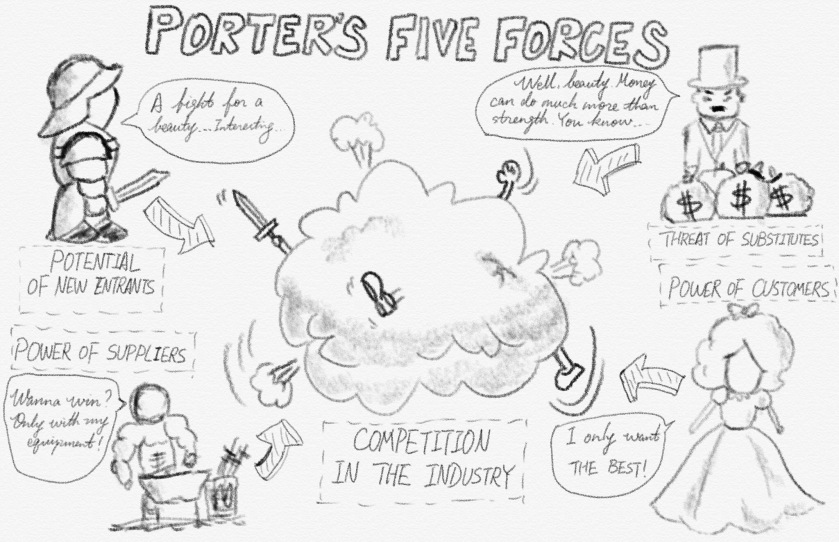
It is the hardest assignment so far in this course. Different from the last sketch in which I struggled with coming up an idea, this time I found the perfect topic – Porter’s Five Forces – as soon as I learned it in the Strategic Management class. Developed by Dr. Porter at Harvard Business School, Porter’s Five Forces is a framework widely utilized to examine the industry and help people understand the market forces that shape the landscape. I naturally took a visual approach to learn the concept and thought Porter’s Five Forces would be a great topic for this visual note-taking assignment.

I employed an analogy to better illustrate the concept. The beauty stands for a customer demanding the best product in the market, representing the power of customers. Knights fighting for the love of the beauty stand for companies fighting for the customer’s money, representing the competition in the industry. The blacksmith stands for a supplier selling armors and weapons to the knights, representing the power of suppliers. The knight away from the fight stands for a potential new competitor, representing the potential of new entrants. Finally, the rich man persuading the beauty to give a higher priority to money than physical strength stands for substitutes that can also meet the customers’ needs, representing the threat of substitutes. Altogether, these five forces determine the profitability and future of an industry.

The hardest part is to put my thoughts on paper because I am not artistic at all. I had not done any drawings since high school, and this was my first time drawing on an iPad, even though I bought my Apple Pencil a long time ago. At first, I just wanted to use some symbols and icons and complete the assignment. However, after seeing Sulaiman’s and Joyce’s works, I decided to push myself and actually draw something. It was very frustrating at the beginning as I had no sense of scale and curvature and failed several times. Then I decided to google some examples and learned from them. At last, I managed to depict my own characters and complete my visual note for Porter’s Five Forces.

Assignment Link: https://eng181f19.davidmorgen.org/assignments/sketches/sketch-3-visual-note-taking/

Sketch 3: Visual Note Taking


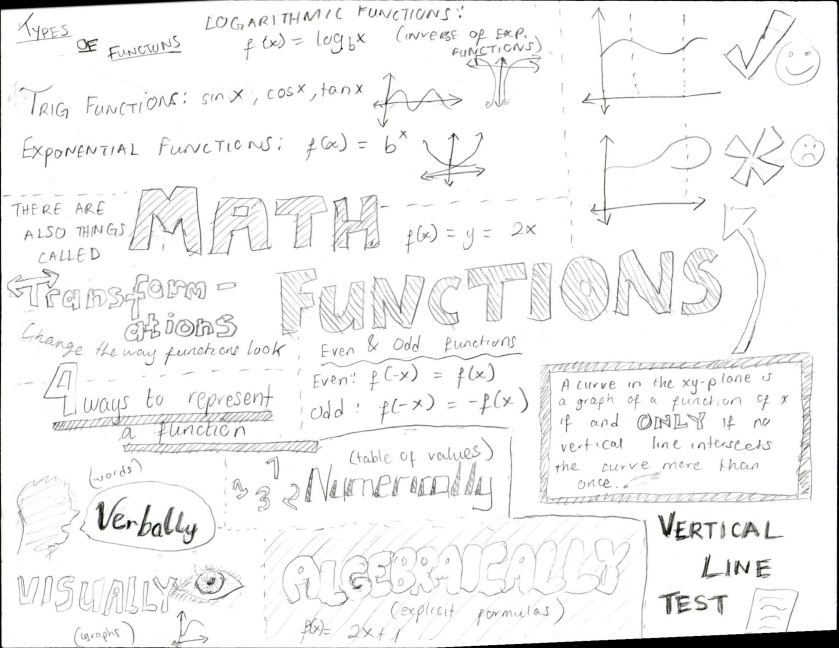
My visual notes represent information from my MATH 111 class on the basics of mathematical functions. Making these visual notes were pretty interesting as I normally don’t pay too much attention to my organization while taking regular notes yet I found myself challenged to organize each section, image, or idea to a location on the paper where it made sense and wasn’t too difficult to understand. I also found making these notes to be very laid-back and even somewhat enjoyable as I wasn’t restricted in any manner. I tend to think about things in portions/sections, and this shows in my visual notes as different things are sectioned away or together. In my opinion, I think that these visual notes are a great way to review information that you already somewhat know as images tend to stick better than text yet sometimes it is hard to convey all the necessary information in images.

Link back to prompt here.

Visual Notes

This week’s Sunday Sketch represents information from the Brain Basics lecture of my Anthropology 200 class. The assignment allowed me to meditate and reorganize the content in my mind that, at first, seemed daunting. The class is cross listed as an NBB class, which intimidated me in the first few weeks of class but I thought as long as the topic stays on primates and human phylogeny I’d be fine. This lecture about the brain was our first in neurobiology. Taking the time to illustrate my notes and attempt to convey the information in another format felt like another method of studying – one that’s more entertaining rereading bullet points on a notebooks page.

Sawyer Steinmiller: Visual Notes

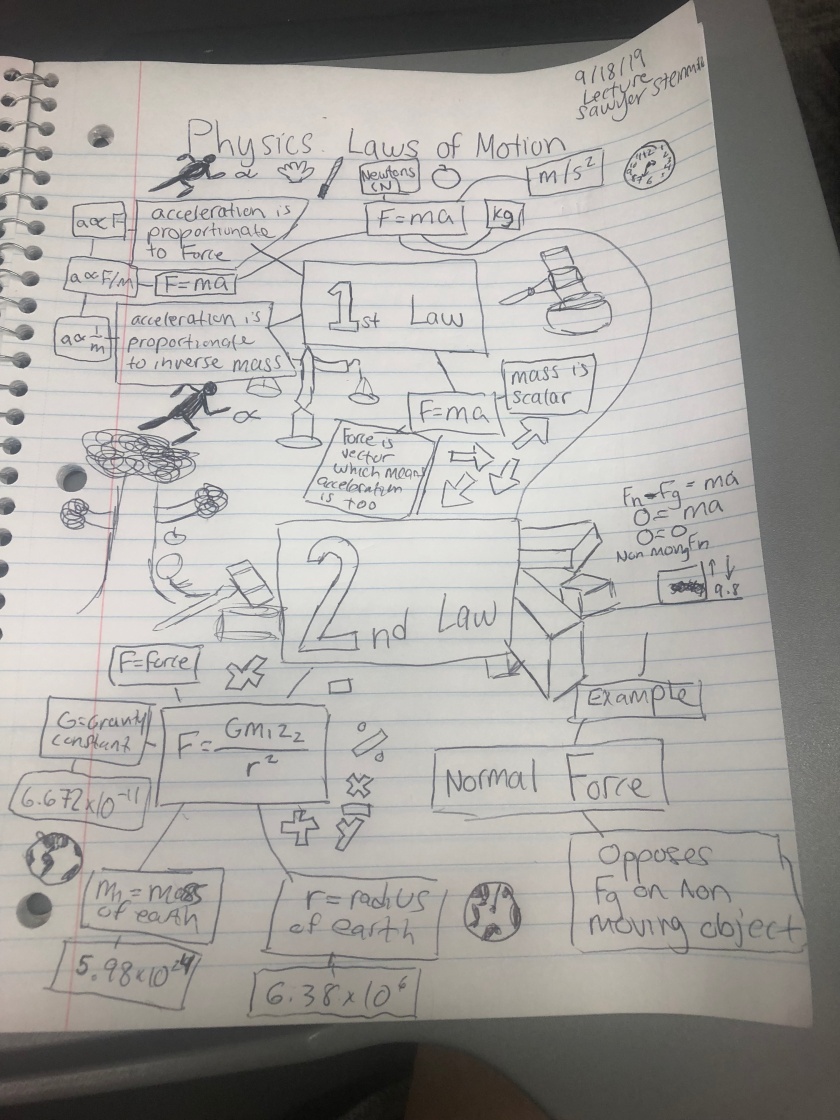
For this visual note taking assignment, I chose to remake my physics notes. This is because physics is my favorite STEM class and it is my hardest. I have never taken a physics class before and although we are going at a quick pace, the material is extremely interesting. Because we are moving at such a fast pace, my notes tend to be messy; I thought that visualizing my notes would be helpful.

During the process, I learned. a lot about how I process information. Personally, the drawing aspect did not help me that much, but the organizational components were extremely helpful. When I normally make my notes, the important parts of the lesson are the same size as the non important parts, so it is hard to visualize what is important and what is not. Here, it is very simple to know what the lesson revolves around because of how central the themes are. I know that I can’t create these types of notes in the moment, but I might go over the important notes and rewrite after the lesson.

Here is the link to the rubric for the assignment: CLICK HERE!

Aesthetics & Astronomy: Visual Note Taking

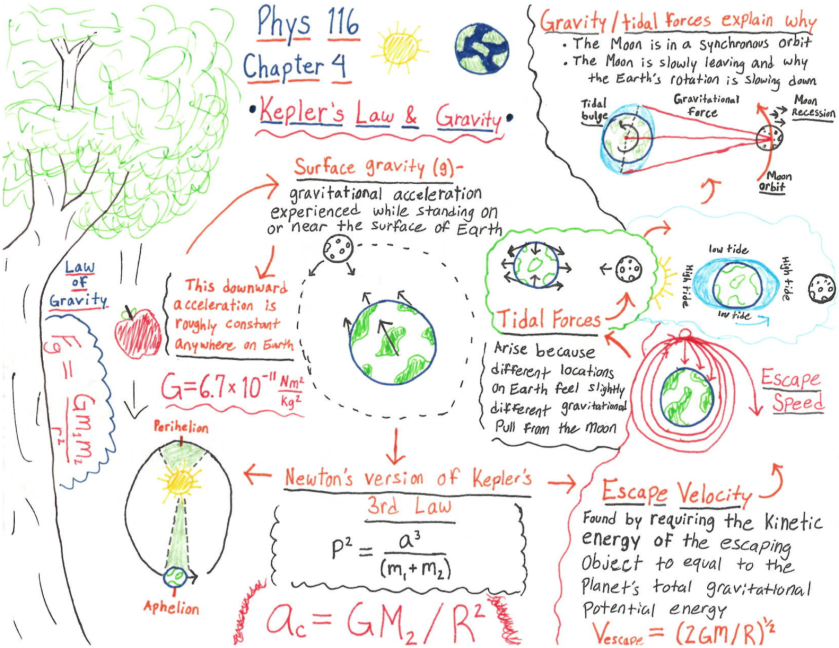
Astronomy requires a lot of visual thinking and necessary observations in order to understand the material throughout the course. Creating visual notes for this class was much more helpful than textual notes could have ever been. While drawing these images and formulating my notes, the concepts of the astronomical ideas I am currently learning were much more understandable. I could visualize the theories and laws more clearly and comprehend the meaning of these new ideas with the pictorial applications in my notes.

While drawing these images I realized just how much of a visual learner I am. I do not believe I could have understood the this chapter of my astronomy class if I had not been able to draw out these images and recognize the true applications of these ideas. Not to mention, I thoroughly enjoyed creating these notes. Usually the notes I take in class are not very intricate and not as understandable as I would like for them to be. Creating my visual notes helped me to go over the information that I’ve learned while having fun making art through these foreign ideas. I’m thankful for the prompt that led me to this new way of understanding my course materials which can be found here.

Visual Note-Taking

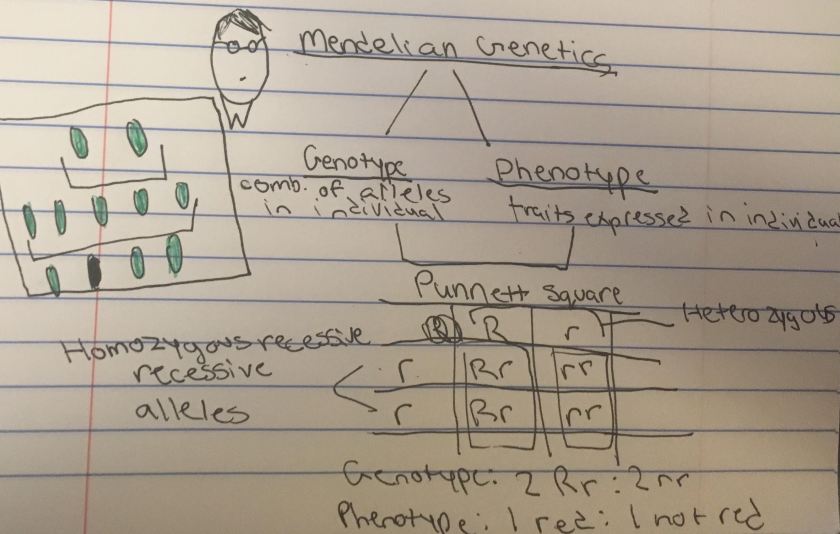
I made a visual version of my notes on Mendelian Genetics from my Biology class for this week’s Sunday Sketch assignment. I had some difficulty deciding how to structure it, but once I was done, I found that it is easier to review notes taken in visual form than it is to review notes taken in written form. It was also much quicker to draw out Mendel’s experiment with filial generations of pea plants than it was to write out paragraphs explaining the experiment. The only concern I have is that if I study visual notes instead of written notes, I will have trouble explaining the concepts in written form on an exam that requires written answers. With written notes, I can memorize what I’ve written so that I can be sure to explain the concepts with clarity on an exam.

Visual Notes Taking

Visual Notes for Art History

For this week’s Sunday Sketch assignment, I recreated my written notes for an Art History lecture as visual notes.

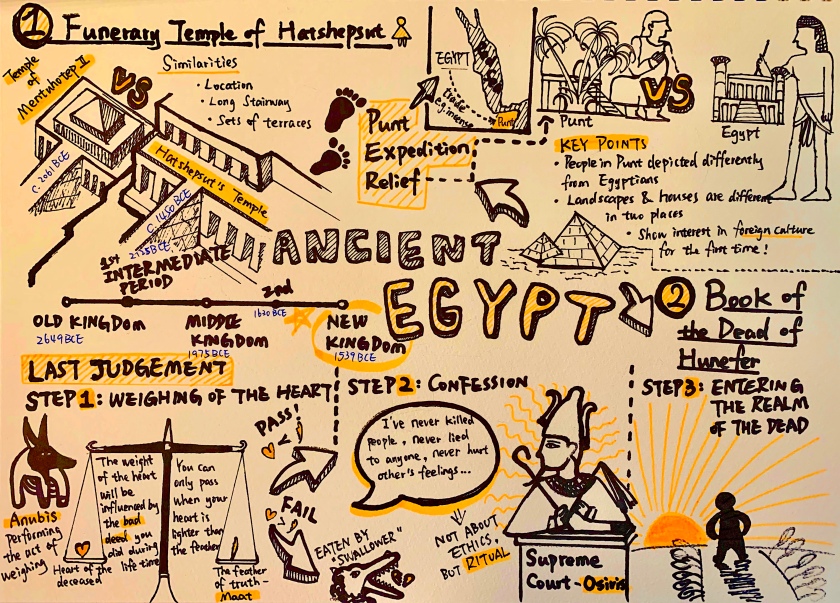
I started out writing the topic “Ancient Egypt” in the center of the page because all the artworks we learned in class were created during this period. I always struggle with memorizing the chronological order of art periods, so this time, I drew a timeline that laid out major art periods during the Egyptian era so it was easier for me to memorize. Also, I highlighted the “New Kingdom” period in the timeline to indicate the focus of this note.

On top of that, visual notes also made comparisons more straightforward. For example, I couldn’t understand the similarities between the Temple of Hatshepsut and Temple of Mentuhotep II when I looked at my original notes. However, drawing the two temples right next to each other gave me a clearer insight into their similarities, and the same goes for the comparison between Punt and Egyptian culture in the upper right corner of the note.

I personally think that images do a better job of connecting things than texts do. When I was creating my visual notes for The Last Judgement from Book of the Dead, I surprisingly found that images and arrows displayed the separate steps of entering the afterlife in a much more logical way than a bunch of texts could ever achieve. Thus, I no longer have a hard time recalling the exact words from my notes but instead describing the artwork using my own words with the visual image in my mind.

css.php