The Secret Language of Comics: Visual Thinking and Writing

Visual Note Taking

Sketch 3
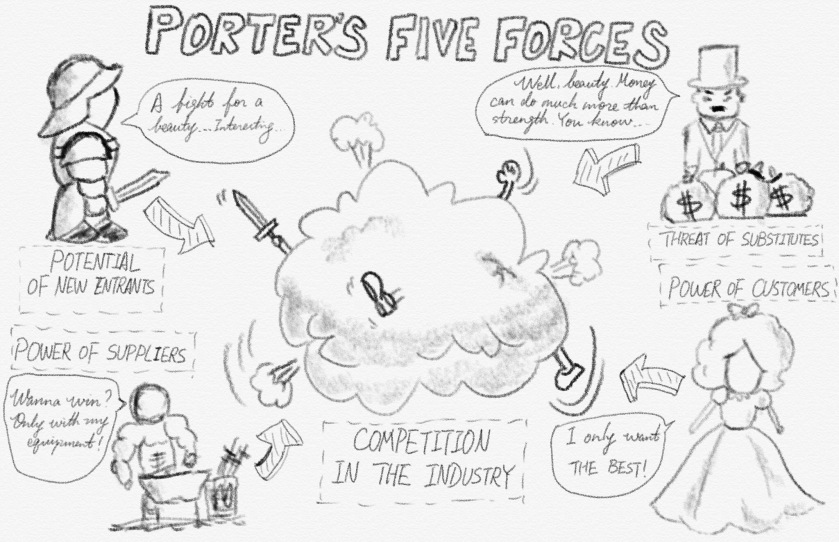
Visual Note for Strategic Management: Porter’s Five Forces

It is the hardest assignment so far in this course. Different from the last sketch in which I struggled with coming up an idea, this time I found the perfect topic – Porter’s Five Forces – as soon as I learned it in the Strategic Management class. Developed by Dr. Porter at Harvard Business School, Porter’s Five Forces is a framework widely utilized to examine the industry and help people understand the market forces that shape the landscape. I naturally took a visual approach to learn the concept and thought Porter’s Five Forces would be a great topic for this visual note-taking assignment.

I employed an analogy to better illustrate the concept. The beauty stands for a customer demanding the best product in the market, representing the power of customers. Knights fighting for the love of the beauty stand for companies fighting for the customer’s money, representing the competition in the industry. The blacksmith stands for a supplier selling armors and weapons to the knights, representing the power of suppliers. The knight away from the fight stands for a potential new competitor, representing the potential of new entrants. Finally, the rich man persuading the beauty to give a higher priority to money than physical strength stands for substitutes that can also meet the customers’ needs, representing the threat of substitutes. Altogether, these five forces determine the profitability and future of an industry.

The hardest part is to put my thoughts on paper because I am not artistic at all. I had not done any drawings since high school, and this was my first time drawing on an iPad, even though I bought my Apple Pencil a long time ago. At first, I just wanted to use some symbols and icons and complete the assignment. However, after seeing Sulaiman’s and Joyce’s works, I decided to push myself and actually draw something. It was very frustrating at the beginning as I had no sense of scale and curvature and failed several times. Then I decided to google some examples and learned from them. At last, I managed to depict my own characters and complete my visual note for Porter’s Five Forces.

Assignment Link: https://eng181f19.davidmorgen.org/assignments/sketches/sketch-3-visual-note-taking/
Sketch 3: Visual Note Taking


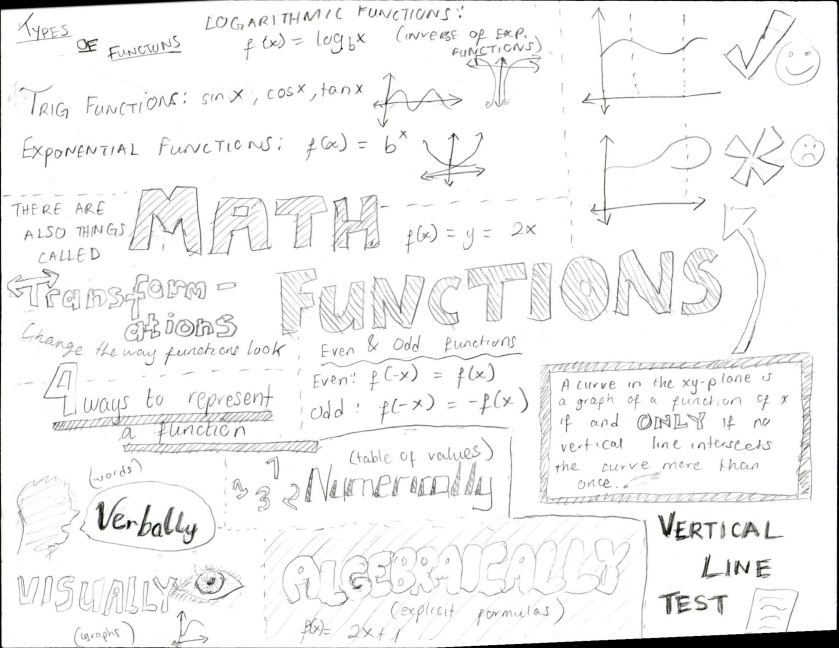
My visual notes represent information from my MATH 111 class on the basics of mathematical functions. Making these visual notes were pretty interesting as I normally don’t pay too much attention to my organization while taking regular notes yet I found myself challenged to organize each section, image, or idea to a location on the paper where it made sense and wasn’t too difficult to understand. I also found making these notes to be very laid-back and even somewhat enjoyable as I wasn’t restricted in any manner. I tend to think about things in portions/sections, and this shows in my visual notes as different things are sectioned away or together. In my opinion, I think that these visual notes are a great way to review information that you already somewhat know as images tend to stick better than text yet sometimes it is hard to convey all the necessary information in images.

Link back to prompt here.

Visual Notes

This week’s Sunday Sketch represents information from the Brain Basics lecture of my Anthropology 200 class. The assignment allowed me to meditate and reorganize the content in my mind that, at first, seemed daunting. The class is cross listed as an NBB class, which intimidated me in the first few weeks of class but I thought as long as the topic stays on primates and human phylogeny I’d be fine. This lecture about the brain was our first in neurobiology. Taking the time to illustrate my notes and attempt to convey the information in another format felt like another method of studying – one that’s more entertaining rereading bullet points on a notebooks page.

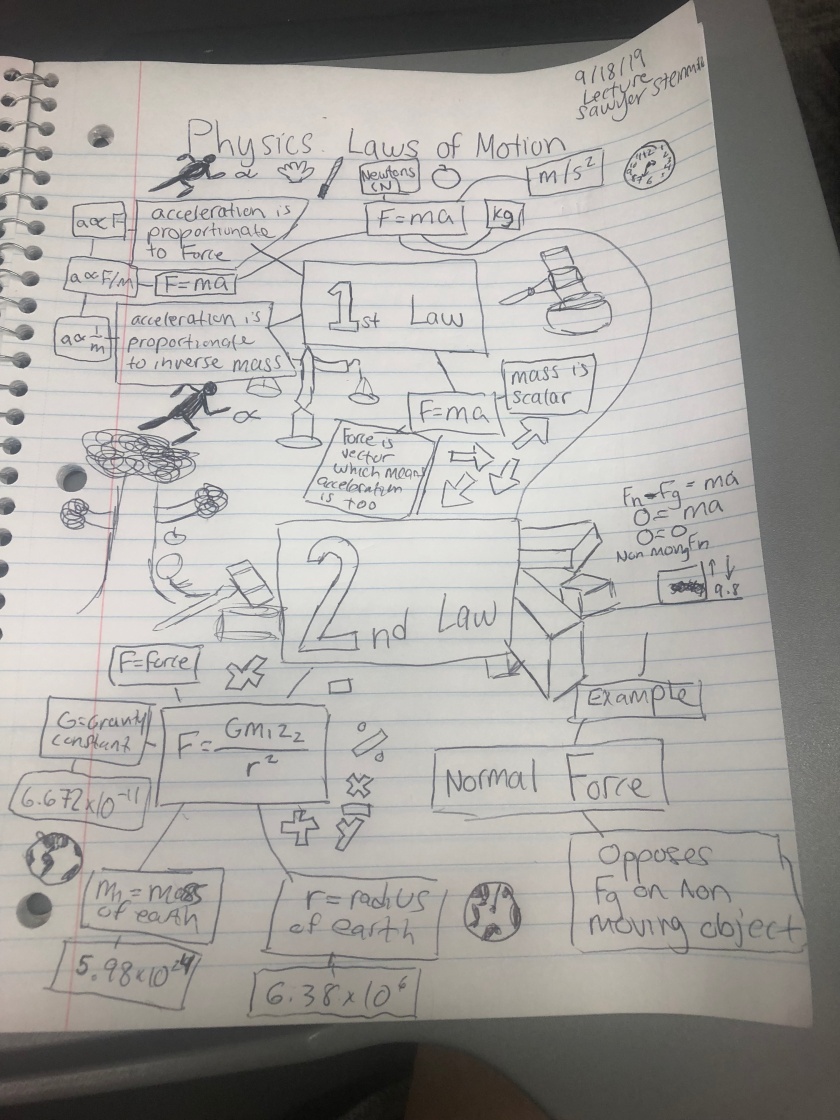
Sawyer Steinmiller: Visual Notes

For this visual note taking assignment, I chose to remake my physics notes. This is because physics is my favorite STEM class and it is my hardest. I have never taken a physics class before and although we are going at a quick pace, the material is extremely interesting. Because we are moving at such a fast pace, my notes tend to be messy; I thought that visualizing my notes would be helpful.

During the process, I learned. a lot about how I process information. Personally, the drawing aspect did not help me that much, but the organizational components were extremely helpful. When I normally make my notes, the important parts of the lesson are the same size as the non important parts, so it is hard to visualize what is important and what is not. Here, it is very simple to know what the lesson revolves around because of how central the themes are. I know that I can’t create these types of notes in the moment, but I might go over the important notes and rewrite after the lesson.

Here is the link to the rubric for the assignment: CLICK HERE!

Aesthetics & Astronomy: Visual Note Taking

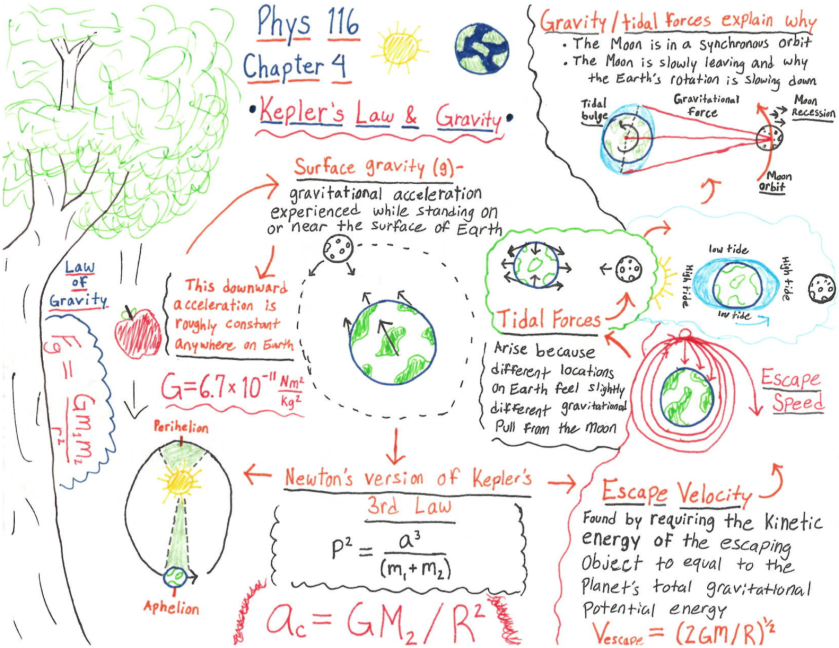
Astronomy requires a lot of visual thinking and necessary observations in order to understand the material throughout the course. Creating visual notes for this class was much more helpful than textual notes could have ever been. While drawing these images and formulating my notes, the concepts of the astronomical ideas I am currently learning were much more understandable. I could visualize the theories and laws more clearly and comprehend the meaning of these new ideas with the pictorial applications in my notes.

While drawing these images I realized just how much of a visual learner I am. I do not believe I could have understood the this chapter of my astronomy class if I had not been able to draw out these images and recognize the true applications of these ideas. Not to mention, I thoroughly enjoyed creating these notes. Usually the notes I take in class are not very intricate and not as understandable as I would like for them to be. Creating my visual notes helped me to go over the information that I’ve learned while having fun making art through these foreign ideas. I’m thankful for the prompt that led me to this new way of understanding my course materials which can be found here.

Visual Note-Taking

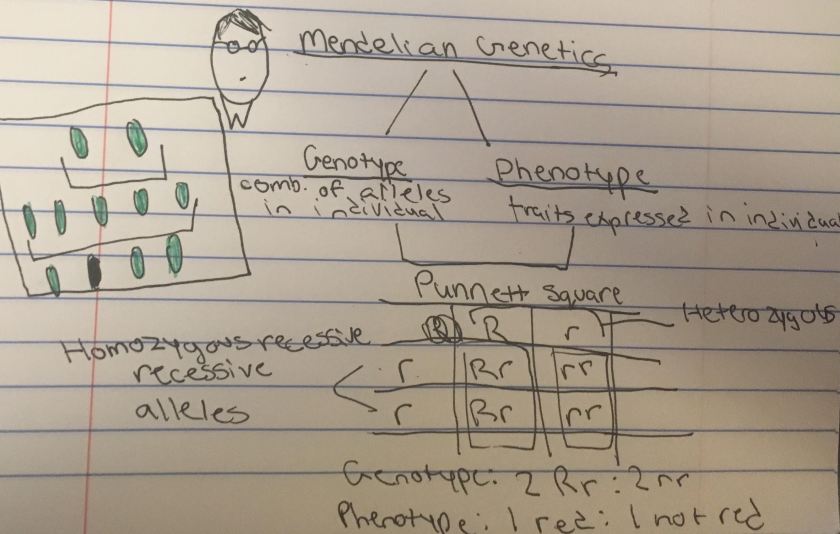
I made a visual version of my notes on Mendelian Genetics from my Biology class for this week’s Sunday Sketch assignment. I had some difficulty deciding how to structure it, but once I was done, I found that it is easier to review notes taken in visual form than it is to review notes taken in written form. It was also much quicker to draw out Mendel’s experiment with filial generations of pea plants than it was to write out paragraphs explaining the experiment. The only concern I have is that if I study visual notes instead of written notes, I will have trouble explaining the concepts in written form on an exam that requires written answers. With written notes, I can memorize what I’ve written so that I can be sure to explain the concepts with clarity on an exam.

Visual Notes Taking

Visual Notes for Art History

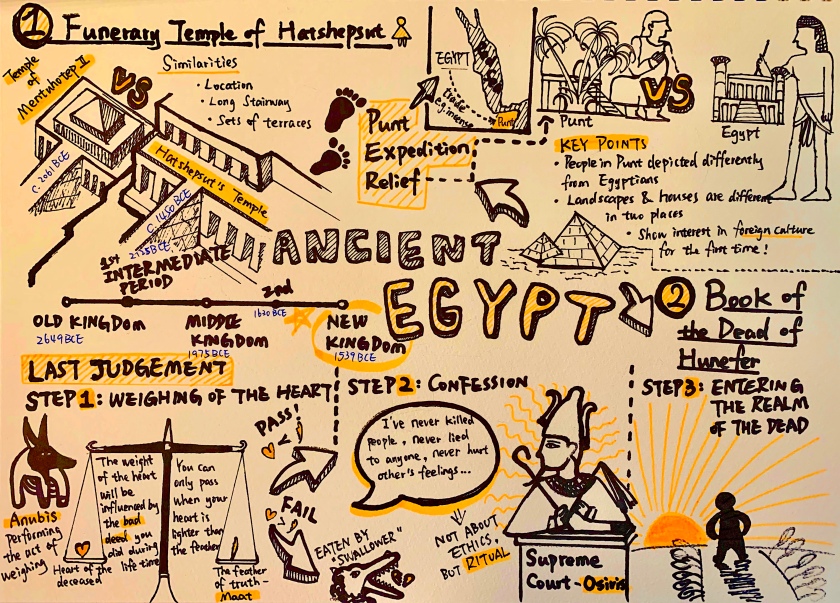
For this week’s Sunday Sketch assignment, I recreated my written notes for an Art History lecture as visual notes.

I started out writing the topic “Ancient Egypt” in the center of the page because all the artworks we learned in class were created during this period. I always struggle with memorizing the chronological order of art periods, so this time, I drew a timeline that laid out major art periods during the Egyptian era so it was easier for me to memorize. Also, I highlighted the “New Kingdom” period in the timeline to indicate the focus of this note.

On top of that, visual notes also made comparisons more straightforward. For example, I couldn’t understand the similarities between the Temple of Hatshepsut and Temple of Mentuhotep II when I looked at my original notes. However, drawing the two temples right next to each other gave me a clearer insight into their similarities, and the same goes for the comparison between Punt and Egyptian culture in the upper right corner of the note.

I personally think that images do a better job of connecting things than texts do. When I was creating my visual notes for The Last Judgement from Book of the Dead, I surprisingly found that images and arrows displayed the separate steps of entering the afterlife in a much more logical way than a bunch of texts could ever achieve. Thus, I no longer have a hard time recalling the exact words from my notes but instead describing the artwork using my own words with the visual image in my mind.

Visual Note Taking

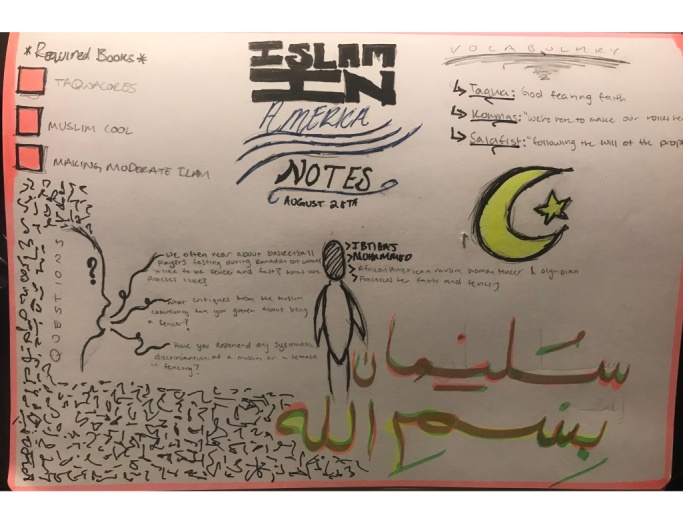
Islam In America Notes

Visual note taking is always something I’ve seen on YouTube yet never tried. It seemed as though it required an immense amount of effortless art, which I couldn’t imitate no matter how hard I tried. Also, during class it can be very hard to focus on what’s being taught and doodling only made that task harder.

This assignment was fun because it allowed me to take something mundane and turn it into art. I also enjoyed this activity because it was low-risk. Often times, when attemping to create a grand art piece, it can become very stressful because one pen stroke could ruin everything. However, with visual note taking, I had the freedom to draw anything that came to my mind because it could be used to remember class content. I can honestly say that I will be able to recall all the notes I drew.

Sketch 3: Visual Note Taking

Due: 9/22
Tag: sk3

Overview

For your sketch assignment this week, I want you to create a set of visual notes for one day in one class (other than this one) that you are currently enrolled in. You do not need to take your visual notes in real time; in fact, I recommend that you don’t. I recommend that you go to your classes and take notes in whatever manner you normally do, then after class go through your notes and recreate them as visual notes.

Giulia Forsyth

Domain of One’s Own by Flickr user Giulia Forsyth

I’m a big fan of the work of Giulia Forsyth. She works in a teaching and learning center, where she helps professors and instructors be more innovative in their teaching practices, and she also works as a visual note-taker and facilitator, which means that she is sometimes employed to go to presentations and meetings and to doodle notes for the meeting.

Check out the four minute video below, where she gives a quick summary of how she began to take her doodling seriously and where it has led her.

On her Visual Practice page, Forsyth has lots of videos and images explaining how she approaches the task of producing drawings that help her and others to not just grab the information that’s been presented in a class or discussion, but to grapple with the material and better understand it. You can also see numerous examples on her Flickr page, especially her Visual Practice album.

Kenneth Robinson

As another example of visual note-taking, you might check out the video below from RSA Animates illustrating a lecture by Kenneth Robinson about educational philosophy. I suspect you’ll find the video much more powerful and engaging because of the illustration that goes along with it than you would if you were simply listening to the audio. What does this mean for your own practice?

Prompt

For your sketch assignment this week, I want you to create a set of visual notes for one day in one class that you are currently enrolled in (probably not this one). You do not need to take your visual notes in real time; in fact, I recommend that you don’t. I recommend that you go to your classes and take notes in whatever manner you normally do, then after class go through your notes and recreate them as visual notes.

You do not need to draw your notes in a digital environment, either, though you are certainly free to do so. If you prefer to doodle with pen, pencil, or marker on paper then do that and once you’re done with your drawing, just scan the pages as JPG files so you can upload them to your site. If you have an iPad or other tablet or would like to draw on your laptop or desktop, then you might try apps like GoodNotes, ProcreateInkflow, or Adobe’s Sketchbook or search for other free/cheap drawing applicationsI am completely tool agnostic on this assignment, so make your drawings in whatever manner make sense to you.

Your visual notes do not need to be polished or beautiful or anywhere near as intricate as Forsyth’s. Do try to take this assignment as an opportunity to really engage differently with your material – don’t just make a series of doodles that follow the outline of the lecture or discussion in your notes but try to translate the concepts and information into a new, visual set of notes. You might think about creating flowcharts or diagrams, which are also visual devices.

Once you’ve got your notes, load them onto your course site as a sketch post. Embed the images from your notes into the post and as you do, take a few moments to reflect on the process and then write a paragraph or two about what you learned during the process of creating your visual notes. Did it help you to understand the course content any differently or better to create notes visually rather than just as text? Did you discover anything new about yourself or the way you think in the process? Did you find it enjoyable or find some aspect of it particularly interesting? Someplace in your reflective text, create a link back to this blog post assignment.

css.php