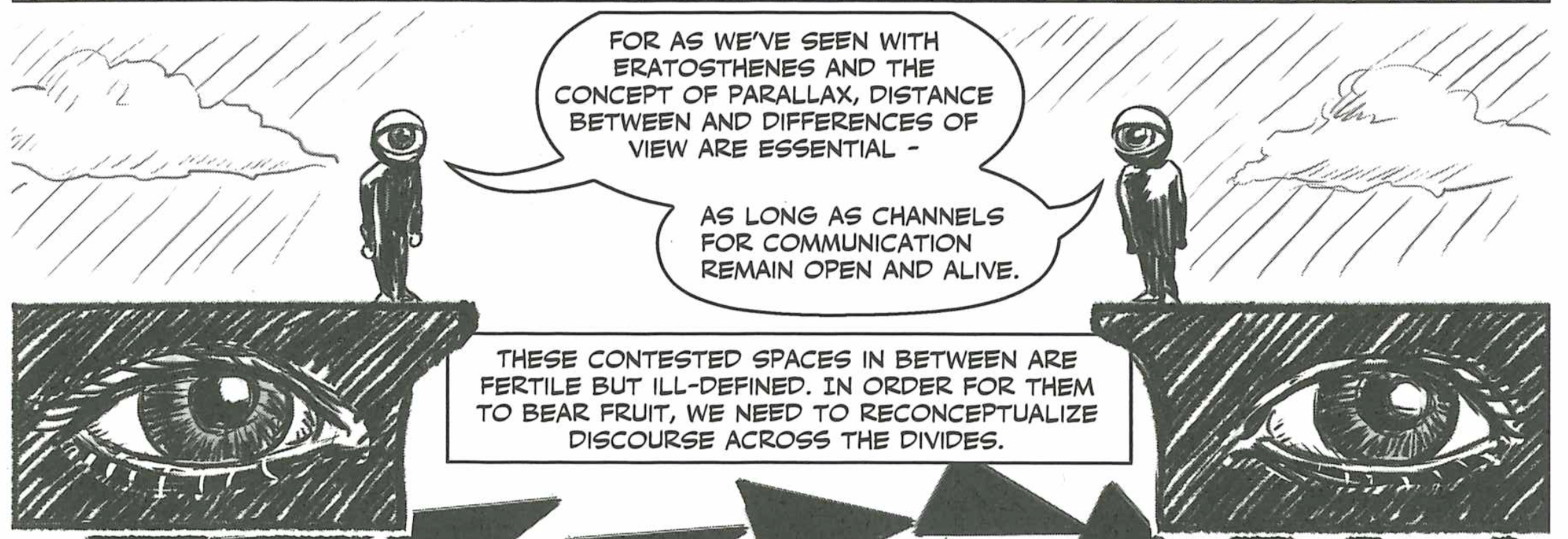
The Secret Language of Comics: Visual Thinking and Writing

Sunday Sketch #1

As I pondered what to do for this assignment, I was scanning my room when I came across this wooden spoon which I had been given when I was initially moving into my dorm room. I picked it up and thought that there had to be something I could use it to create and started to constantly turn it around looking at it from different perspectives. I turned it completely upside down and that’s when it hit me that it looked similar to a boat paddle. Originally, I was going to do a simple sketch with someone holding the paddle as he/she rowed through a body of water however once I began drawing, I kept on adding more detail and shading to the point where I had only drawn the boat after a good amount of time. Due to this, I decided to abandon the idea of a person holding the paddle but rather to have the paddle become attached to the boat alongside one other drawn one. I’m quite satisfied with the finished product.

Sunday Sketch 2

“Kisses on the Cock”
By Sulaiman Rashid

The process of creating this sketch was relatively simple and straightforward. I looked around my dorm for small items that could be captured in a drawing. I eventuallty found some Hershey Kisses, and they reminded me of fat lips when you put them together. I used some Blue-Tak to stick the two kisses together to create the lips. Once I had my object, I had to figure out what sketch would surround the item. I first started with a human face but quickly found that it was too challenging to incorporate an object with different proportions. 

I ended up sketching a chicken face because I found a basic tutorial on how to draw chicken faces. After following the tutorial, I added in elements of my style and ended up with “Kisses on the Cock.” Upon finishing the sketch, the name seemed to fit perfectly; it was witty, funny, and hopefully not too inappropriate for class.   

Writing Narrative Reflection

What is writing? What makes one a good writer? Generaly when we talk of writing we all imagine these long essays, books and articles, but in reality every text we send, every caption we prepare, every comment we post is a piece of writing. It is a piece of writing that has potential to change someones mood, day or even life. Now not every word will move mountains, but each word has meaning. These meanings are often powered by our relationship to them that we have developed throughout our reading and writing journey. Check out my journey here.

A Reflection Upon “From ‘Creak Creak’ to ‘Swoosh’”


In my narrative, I explore my childhood experience of learning to read using graphic books and how this shaped me as a visual learner. I then move forward along the timeline and explain how reading and writing pure texts stressed me out as a visual learner in middle school and how I became both a better writer and reader afterward. For the high school period, I focused on portraying my experience of publishing articles online and how this experience led to my discovery of the power of combining written words and visual images.

The free writing exercise was definitely very helpful. In the beginning, I was stuck, but after I started writing I could recall more and more details and added them into my final essay. Still, the actual writing process took much longer than I thought. We are asked to reflect on our experiences that shape the way we READ and WRITE, not just either one of them. Therefore, what troubled me the most when writing this essay was how to carry out this “evolution” in a way that neither one of the two elements was missing. I can easily think of a lot of my experiences on this topic, but there are not that many of them that BOTH influence the way I read and write. In the end, I managed to select four of my experiences that touched on both aspects and structured them into three sections divided by different time periods. Instead of simply call them “childhood”, “middle school”, and “high school”, I was inspired by Stitches to incorporate the use of sounds in my essay. Therefore, I gave every period a particular sound that represents my experiences and set them as subtitles which I think will be interesting to read.

I think the most interesting part of my essay is:

“‘Tac tac’
This was the sound of me pressing my delete key.
‘Tac tac’
I was trying to write something new.
‘Tac tac’
I was deleting it again.
I can still recall those late nights when I watched the cursor blinking and ticking on my screen like the countdown of a time bomb.”

This shows my exact feeling when struggling to write an essay, and I bet many people feel the same.

When I look back at my finished essay, I am surprised by how different it is from the original outline I listed. I got this idea that writing is an “ever-changing” process through which the structure, content, wording, and even topic of the essay can be changed millions of times, and there is no perfect essay but only a better one.

https://joyfuljoyce717.wordpress.com/literacy-narrative/
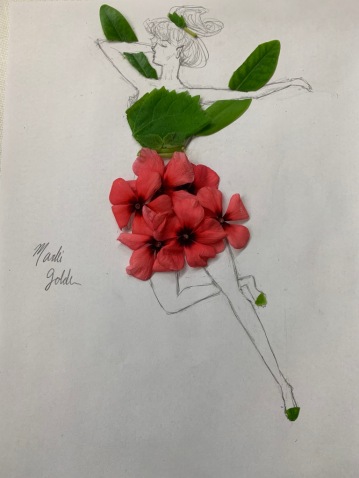
A Fairy Good Sunday Sketch

I was walking to the library when I noticed a bunch of pink flowers surrounding a bike stand. They reminded me of the design accounts I follow on Instagram that incorporate nature with fashion. Inspiration struck, and I was off looking for fallen flowers and other pieces of nature on my way to the library. One of my many passions is fashion design. I used to fantasize about it as a career, but reality struck, and my secret desire was pushed aside to the margins of my notebooks. This sketch assignment gave me the opportunity to embrace fashion design in a creative way. The dainty flowers and earthy leaves immediately made me think of a fairy. After sketching the base, I mixed and matched until the outfit and wings resembled something of a fashionable fairy. Is it perfect? No. Did I have fun and do I want to continue making outfits out of nature? Yes. The process of making and uploading this sketch also proved much easier than the first sketch, making me feel hopeful about my technological abilites moving forward.

Literacy Narrative Reflection

Part I

Going in to this narrative I was really worried because I haven’t written anything all summer and I’m a little out of practice. Thankfully I was able to remember the writing process and started with an outline where I was able to map out the foundation of my narrative. The freewriting pre work was very beneficial to my literacy narrative because it allowed me to take a raw idea and expand upon it. Often times the hardest part in writing is getting started and the freewriting activity took care of that. I decided to make this narrative about my poetry and I never realized how big of an impact my poems had on me until I finished the narrative. Also, before writing this assignment I never considered that my brother was actually the biggest influence that sparked my interest in poetry.

This literacy narrative was the first time I’ve publicly talked about and shared my poetry. It was defintley intimidating to share something so personal with so many people but I’m happy I was able to step out of my comfort zone. I believe the most interesting sentence in my narrative is when I said “What came forth was poetry.” I think that sentence changes the dynamic of the narrative. It shifts the readers perspective about who I am as a writer and a poet.

Link to Literacy Narrative: https://sulistories.wordpress.com/literacy-narratives/

Literacy Narrative pt. 1 Reflection

My process for writing this narrative consisted of me drawing out a time line on a piece of paper and marking it with important dates that had to do with reading and/or writing. I just started putting down as many memories as I could remember without thinking about what they were or how all the memories fit together. When I stepped back and looked at the timeline, I realized that there was a clear pattern of my experience reading. I found it surprising that as a kid I read so much, and all of a sudden, I didn’t read books at all. I hadn’t even realized that I had done that because I was always so distracted using my phone. I think the most interesting sentence in my essay is: “As time went on I slowly spent more and more time using my phone and less time reading, which led to less motivation to write.” I believe that this sentence highlights how my love for reading slowly deteriorated as I spent more time using technology. This sentence is also very relatable for many other teens as I feel as if my experience is shared among many of my peers. 

Literacy Narrative:

https://wordpress.com/block-editor/page/nixstudent.wordpress.com/29

Reflection for Literacy Narrative Part 1

In my Literacy Narrative, I explored how being a slow reader in Kindergarten had a lasting impact on how I viewed myself and prevented me from growing because I was too afraid to admit that I wasn’t a good reader. This sentiment is captured in the sentence: “From a young age I compared myself to those around me and concealed my insufficiencies, rather than working to improve them.” This sentence is especially interesting to readers because it explains how it was not the typical cognitive challenges that prevented me from becoming a more proficient reader, but rather it was my social anxiety about not measuring up.

I enjoyed being tasked with thinking about old childhood memories because not often do I get the chance to reminisce on old significant moments in my life. Since I’ve been doing a lot of reflecting on my reading career particularly in the last year, I was already cognizant of my evolution as a reader; however, through writing out and analyzing these memories I gained greater insight into how my social anxieties about measuring up to others shaped the way I viewed myself as a reader for so many years. The initial process of free writing contributed to my narrative in that it made it more anecdotal, whereas otherwise I would have adhered to a more traditional analytical essay style.

Click here to read the whole narrative: https://isabelwallgren.wordpress.com/literacy-narrative/

Literacy Narrative, Part 1 Reflection Post

LITERACY NARRATIVE PART 1 REFLECTION

The process of writing the literacy narrative seemed unconventional to me. I’ve never had to include images in my writing. The freewriting exercises felt a bit strange. I’ve never undergone the process of writing in a limited amount of time about anything that comes to mind. Though by the time I finished writing my narrative, I realized that I was a critic of sorts. Throughout high school, I became more selective about fantasy novels in particular. 

I want fantasy novels to at least have the theme of moral ambiguity, and extensive character development is a requirement for me. While writing the narrative I felt like I limited reading to only novels and fiction, but at the same time I had to understand my rhetorical situation and to write keeping in mind the constraints listed, so, I focused on the aspects of reading novels. I chose two images to incorporate into my writing. The first image is a representation of dark fantasy while the second image shows the dark and gloomy world of A Song of Ice and Fire.

The most interesting sentence: “Moral ambiguity, meticulous character development and the overcomplication of the struggle between good and evil made the series unique. I felt that we like Martin’s characters are forced to navigate the world with different definitions of morality. Martin showed that as in Game of Thrones you have to be a snake to “climb the ladder” in the real world. There is no good or bad”.

Literacy Narrative URL: https://haiderblogcom.wordpress.com/blog/blog/


Image source: https://www.google.com/url?sa=i&source=images&cd=&ved=2ahUKEwim9s21-8rkAhVtZN8KHab9CvUQjhx6BAgBEAI&url=https%3A%2F%2Fwww.ibmastery.com%2Fblog%2Fhow-to-write-ib-extended-essay-reflections&psig=AOvVaw2mTip22z1RcG3NeVc3FbFd&ust=1568366695740982

About My About Me

Traveling in a time machine of self-reflection, I have returned with a few artifacts of my past and created an About Me page (which is titled “my life stuff” because I’m apparently quite extra). Therein lay the books that impacted the impressionable young me, teaching me lessons that are at once profound and pointless; in short, they perfectly applied to life.

Picking out several parts from the cactus of childhood memories has reopened a few wounds, especially the heartache and despair that accompanied those final chapters of Old Yeller ⁠— it is an universal truth: all dog books are bad news. Yet those referenced tales have become a part of me in some way, so I guess there’s no use in protesting the pain of a few pages.

I, however, have learned a solemn and sad truth: I am not the reader I once was. My elementary-school self would annihilate me with his AR-test prowess in a second. Yet I shouldn’t be so swift to disparage my present state, for though I may not read as much on my “free time,” I am positively plowing through more pages than my little third-grade mind could ever handle. Thank goodness for this, too, for my lack of progress would have made quite the frightening example of the American school system.

A picture is worth a thousand words, so expect the word count of that page to climb quite quickly as I add in a few extra stick figures here and there. Like the family fridge, it will only display my best drawings, so don’t expect too much.

css.php