The Secret Language of Comics: Visual Thinking and Writing

The Happiest Place on Earth

A few weeks ago I took a trip down to Florida to spend the day at Disney World with my sister, my mom, my mom’s friend, and her children. As someone who isn’t used to being around many children, it often got very tiresome listening to their arguing, complaining, and just overall incompetence. Throughout the day, one of the children continuously fell behind our group as we traveled through the busy park and eventually we could no longer find her. Her mother rightfully began freaking out and searching all over the surrounding area. Five or ten minutes later when we were about ready to send out a full search and rescue party she nonchalantly walked back up to us with a turkey leg in her hand and not a care in the world. When trying to decide on a story for my comic I thought back to this moment with the suspense and unexpected ending and knew it would be the perfect one to share. Having a very limited space to recreate this story I wanted to focus on the overall progression of the events. I centered in on the initial reactions, the development of the settings, and the unanticipated ending that arose. The Tell a True Story Assignment gave me the opportunity to look back at the past few weeks and find the event which would best be framed into a comedic short comic. I really enjoy this particular memory and thus this assignment as well.

Last Friday Night

Telling a true story in so few panels with so few words felt less like writing a “story” and more like writing a moment. The moment I chose was my Friday night when I accidentally slept through everything and me and a friend ended up watching movies on my floor all night instead of going out. My week was pretty uneventful, and the anticlimactic nature of this particular moment/day in my week encompasses that feeling. The most important choices I made in making this comic were choices of which moments to frame. I tried to make it so that panels work and progress the story along even if they have no text.

Cousins? More Like Monsters…

When starting my thought process for this assignment it was funny to me that this was the first thing I thought about to use to create my true story. Yes, this story is 100% true. No add-ons, nothing exaggerated, pure truth. To explain it in words, when I was younger my three very evil and older guy cousins would be over my house all the time and would basically bully me in my own home. This particular time they decided to pull a prank on me because I really wanted to go to the park but they wouldn’t take me but they tricked me into thinking we were by leading me outside and towards the park. Unfortunately, towards the park is also towards the train tracks at the end of my street. And thats where they put me and ran away without me.

It’s a sad funny story that I occasionally remember but I make them pay for it now that I’m older by having them buy me things of course. Since they wanted to be monsters when I was innocent this is what happens. Drawing the comic was a hilarious moment for me as well because I got to give them all evil faces which makes it even more funny when you have no idea whats going to come next in my opinion. This has been one of my favorite comics and assignments thus far.

A Story From The Museum

Last week, as I was thinking of a story to use for this assignment I was working my shift at the museum. Just as I was thinking that there might be an event at work that I could use I saw a kid dismiss an artifact and ask to go home. Upon observing this I wondered if different people would react differently to the same piece. By the end of the day I noticed that people’s reaction varied drastically. In an attempt to tie all the different encounters together I created an affirmation comic. While the first two panels after the cover panel show negative reactions or dismissals towards the artifact. The comic ends with two panels that show that all artifacts (or people) are beautiful and valuable to the right viewer.

When You Watch Too Many Experimental Films in One Week…

As far as true stories go, this one’s rather false. The specifics at least are rather contrived, but I guess “the essence” — if I can use that word without being branded pedantic and pretentious — is true … in a way. Also, I definitely bit off a bit more than I could chew with this project, and I was most definitely influenced by the plethora of experimental flicks I had to watch for my FILM 270 class this past week, so looking back on this crazy creation, I don’t know how proud I ought to be; probably a very minuscule amount, if any.

The story I chose to tell, that of a reader noticing the words on the page reflecting his life before his eyes, was chosen primarily from my want to experiment with the growing size of the panels that this project required. The increase in length from Panel 1 to Panel 2 (the visuals appear the same online, but each panel doubles in size as the comic goes along) reminded me of opening a book, and the following increase in height from Panel 2 to Panel 3 mirrored the act of looking up from said book. I tried to make the reflective nature more abstract and slightly more disturbing as the comic goes along, with the plot becoming uncomfortably illogical and peculiar as the panels grew. Furthermore, the final panel shows a mix between the once lower-words and upper images, as if the two sides finally had no choice but to come together as one. I know I have, to put it lightly, artistic limits when it comes to creating clear, complex visuals, so I tried to adapt by accompanying these images with reflective words and making the blurry uncertainty a goal. It kind of got a bit too crazy by the end, but I guess that’s what makes it “The Book of Life.”

Note: My name is most certainly not Albert Scott.

Modern Solitude

Modern Solitude

Compared with “telling a true story”, I would change it to “telling a true moment” due to the limited space I have for this assignment. No matter it is a story or a moment, it has to be true and meaningful enough to record it as a short comic. But I do not live in a drama so I believe to find a meaningful moment should be easier. I looked for some strong and special feelings that I felt in the past moments.

The moment represented above was on my last birthday. It was the coldest day so far this year and I had been working on all kinds of assignments and staying up late for many days. I was tired, cold, and stressed, waiting for the last shuttle alone. After midnight, my family and friends were bombing my phone with their love and wishes, which created that interesting feeling at that moment. I knew I was being cared for and loved by many, and I felt touched and grateful. On the other hand, no one would know what I was experiencing, and I would not share it. I just felt like I should not. In that sense, I was isolated. My phone but not people was the closest to me, which is powerful but also has its own limitations.

There are not many words and it is just about the feeling. And I decide to call it the “Modern Solitude”.


Assignment Link: https://eng181f19.davidmorgen.org/assignments/sketches/sketch-7-tell-a-true-story/

Marlie’s Thoughts 2019-11-24 23:30:19

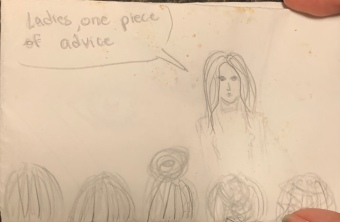
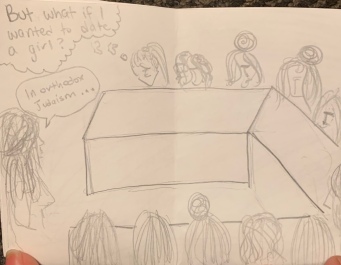
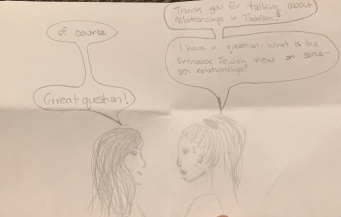
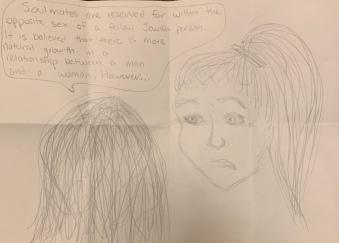
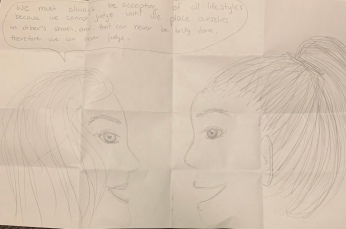
When we discussed this prompt in class, I had this experience the night before and knew I wanted to use it. I am in Meor, a club that had Jewish speakers come and speak about modern-day Judaism. During a few of the sessions I have wanted to ask this question about the acceptance of homosexuality, but only with this speaker did I feel comfortable enough to do so. She is a popular Orthodox speaker and dating coach and discussed her journey in becoming Orthodox after college and her dating life advice. She only spoke about the relationships between men and women, but she also mentioned that she minored in Women’s Gender Studies in college, so I thought this would be the best opportunity to ask about homosexuality. I wanted to draw the reader in with one of the funny things she said, like date foreign boys, and then have the comic take a turn towards serious content. I realized this discussion doesn’t have the most interesting visuals, but that gave me more opportunity to focus on drawing something other than stick figures. 

Literacy Narrative Comic Reflection

Creating the comic for my literacy narrative was actually a lot of fun and pretty easy. It’s the first time ever in my life that I created a comic based on a piece of writing that I wrote myself. Making the actual comic wasn’t too different than writing my literacy narrative. This is because, I used the same strategy for all 12 of my panels. I wrote a variation of my topic sentence from each paragraph and used that as the narrative, and then looked at the rest of the paragraph, and visualized what that would look like. I then just repeated that process.

Once the visual component was added to my literacy narrative I think it really brought my story to life. However, I wrote my literacy narrative knowing that I would turn it into a comic, and so I really tried visualize everything while writing it. That’s why my thinking once the visual component was added didn’t change that much. I do think though, that the addition of drawings helped further my arguments and the message I was trying to convey. Overall my analytical thinking process wasn’t too different.

My ideas really didn’t change that much from the alphabetic version to the comic. I relied heavily on the alphabetic version in order to create my comic and as a result I feel like a lot of my ideas are constant between the two of them. There were though, a few parts in my alphabetic version that I had trouble visualizing and as a result had to create a panel without help from my alphabetic version.

I know that we still have one part of the literacy narrative to do, but after completing the first two parts I definitely think that I have met a lot of the “learning outcomes”. For example, this assignment helped me a lot in my writing process as I constantly reread and revised the alphabetical part of my literacy narrative. I also enhanced my visual thinking and creativity. By converting words into pictures it really made me visualize the words so I could draw something that depicted that. Although, throughout the year I have worked on my digital identity and use of technology, for me this assignment did not involve any technological aspect. Because I hand drew everything there was no need for a comic software or consideration of intellectual property.

https://wordpress.com/block-editor/page/apgwriting.wordpress.com/174

Empty Nostalgia: Literacy Narrative Redraft

The first significant memory I have of reading comes from the story of the children’s book Harold and the Purple Crayon. I don’t directly remember reading the book when I was little, but rather, I recall finding it again on my bedroom bookshelf, looking through the small pages of the book, and remembering how much I loved the story in my earliest years of life. At this point, however, I did not actually remember the storyline of Harold’s journey, but was instead comforted by the creative feeling the book still inspired in my ten-year-old self. The nostalgia of the beautifully simplistic artistic narrative is –to this day– the most poignant aspect of the book for me. I connected my love for drawing and imagination to the story of Harold –as he created his own world and adventures with just a purple crayon and his mind– even though I forgot what he actually created in the story. It seemed that the experience of reading Harold and the Purple Crayon was so integrally molded into my psyche that I could not conjure any direct memories of the book, and instead could only feel the nostalgia for the original experience from my earliest years of reading.

This wistfulness for the experience of my youth has woven itself into my consciousness throughout my life. In my Junior year of high school –one of the most stressful years for me– I found myself drawn back to the bookshelf of my childhood. Just as I did when I was ten years old, I searched my shelves for older books that struck some deep emotional chord with me. My eyes flirted from title to title, yet I was left with this fuzzy feeling of disappointment, as I realized the affection I had assigned to these novels did not have any specific memory of the actual content within them. I have always idolized my childhood as a paradigm of happiness and freedom, and to discover that the foundational children’s books that allowed me to explore my early imagination seemed to be nothing more than empty feelings of nostalgia was disheartening. At the time I knew that a part of me wanted a distraction from my responsibilities of Junior year –grades, college, my future– so I allowed myself to delve back into the novels of my youth. I discovered a comforting sense of childhood joy in reliving the pages of works such as Calvin and Hobbes, Dr. Seus, Bone, and, in particular, Harold and the Purple Crayon.

Looking back now, however, I believe there is a deeper rational in my attraction to revisiting the experiences of my youth. Now that I am living independently in college, and I have officially moved away from the idea of myself as a child, I find myself slowly coming to terms with the experience of my youth. Over the summer I stumbled upon some old home videos of myself when I was little. This unexpected discovery was particularly exciting for myself as it gave me a direct observation of what I was like as a child. To be completely honest, despite how much I have idolized the early years of living without responsibilities, I still struggle with remembering most of my adolescence. In my Junior year of high school, I believe I was facing this same struggle on a subconscious level. I was aware of the general feeling I had from my youth when I read those books, but I became disconcerted to realize that I had forgotten the actual content of the books, and by extension, the content of my adolescent imagination. When I reread my children’s books I got to remember what it was like to be a child again, but additionally, I could prove to myself that the experiences of my childhood were real, and not some distant fuzzy feeling of nostalgia.
The Constant Redrafting of this Project and My Life: A Literacy Narrative Reflection

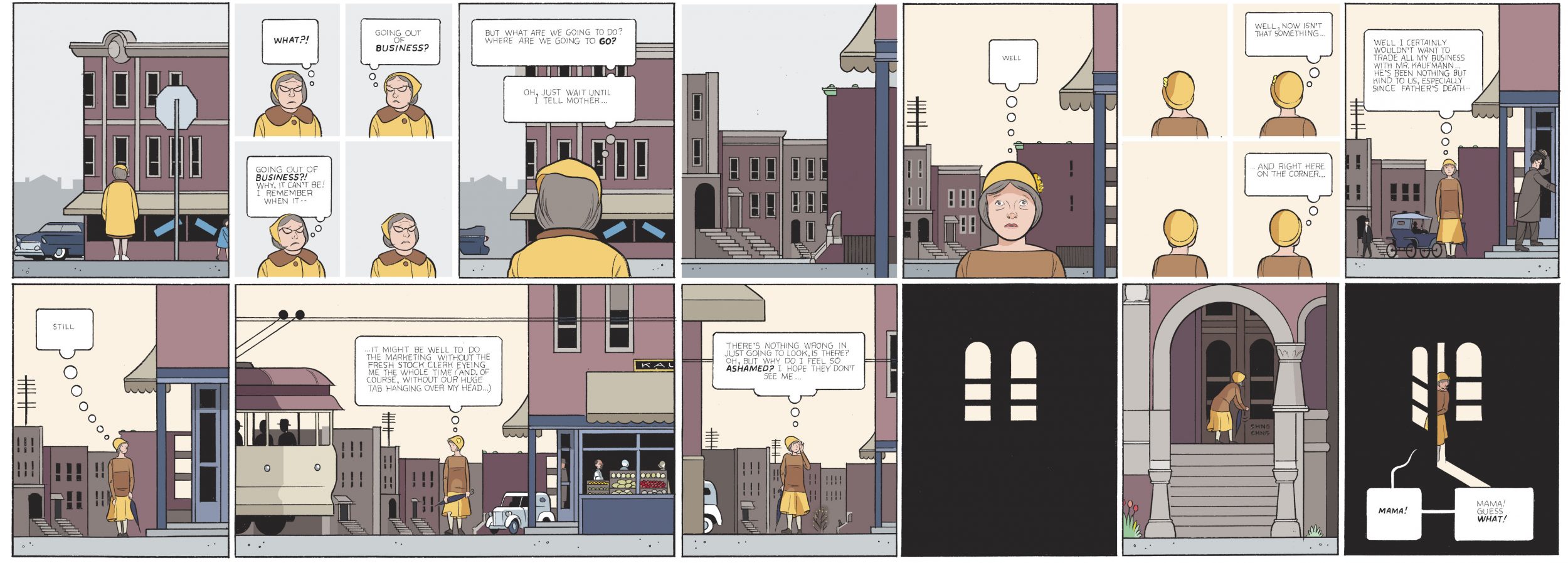
The hardest part about turning my written essay into a visual comic was putting my pencil to the page to begin drawing. I spent most of my time planning out what I wanted in my head so much so that sometimes I found myself stuck for days working on the same page, without even beginning to draw. The most important stylistic aspect that I wanted to include in my piece was a sense of a full page piece of art. I didn’t want to separate the bits into simple blocks of text and image, but rather, I wanted to create that feeling of “all-at-onceness” when one turns to the next page.

This odd stylistic determination was probably the biggest hindrance to me actually making the comic. For each page before I could make a mark I had to ask myself: what is the purpose of this page? And then I tried to come up with a way to convey that feeling as an entire page, while at the same time spacing in smaller moments of plot structure that still connected to the page as a whole. This thematic sectioning by page also forced me to boil down my essay to the core feelings and ideas I needed to convey to properly show my story visually. In this way I actually rethought a lot of my narrative. How is one supposed to represent the feeling of nostalgia in a drawing? What is the true story I am trying to tell? When I asked myself these questions I ended up changing the actual story slightly. Instead of feeling forlorn at the apparent emptiness of my nostalgia for my childhood, I became inspired to draw again from reading Harold and the Purple Crayon. Both of these feelings are true and both still relate to the feelings my childhood books leave with me, but in my written narrative it was easier to focus on the abstract concept of nostalgia while in my graphic narrative it was easier to convey the desire to draw. In some ways though I believe those are similar things. I’m not sure if I managed to properly convey this in my graphic, but to me the nostalgia for a time when I could spend the entire day sitting around in my room reading and drawing is very real. The fact that this is a simplified narrative –which shifted from the idea of an empty nostalgia and towards the artistic inspiration and fulfillment I received from reliving my childhood– does not discredit the reality of the new visual story.

I played around with the fourth wall breaking idea of Harold for a while before I settled down on the final version. At first I was imagining a scene in which Harold quite literally draws my childhood memories, or even having a younger version of myself draws my memories. Had I more time I would have loved to incorporate color into the piece, either having Harold and my childhood in color, or having everything be black and white until I re-read Harold and the Purple Crayon in a dazzling panel in which I jump inside the world of the book and begin coloring in my old memories alongside Harold. When I was drawing out the middle couple pages of the graphic my mind stumbled upon the visual of me drawing Harold and Harold drawing me. Almost a ying-yang, snake eating its own tail, balance sort of thing. If I were to create a cover for this piece it would certainly consist of that. This image struck a deeper chord in me. To me it speaks to how we are constantly drawing from our pasts and how we are also constantly redrawing our own pasts. Every time I read Harold and the Purple Crayon –or any book for that matter– I am redrawing and reshaping the experience that I previously had from it. I am taking that initial feeling and molding it into a slightly different version. I don’t know if that came across in the story of the comic but I was definitely thinking about that in the involvement of Harold throughout my piece.

css.php