Due: 10/20
In the week or two leading up to this assignment, be on the lookout for a moment that is worth representing in a comic — watch for some sort of small adventure you might take, or a conversation you are part of, or a conversation you hear, and as you come upon them take notes for yourself and maybe make quick little sketches or take photos to capture images for later. Your story does not need to be momentous. You do not need to be able to fully grasp its significance, such as it is. But watch for a story that seems to be a little window into some sort of meaning or that might show something interesting to readers.
Then create a short comic that portrays that moment as truthfully as you can in a way that combines both words and images.
If you’d like, you can make a comic with words to only a few images. Or you can make a comic with only a few words. You can use photographs or draw something or create some other sort of visuals. You can tell a funny story or a sad one, or draw on other emotions.
The only two firm requirements are that your comic needs to have words and images and it needs to show something true … with the full understanding that “truth” is a complicated and contested state of being. (Your story does not have to be a true war story; it only needs to be true.)
That said, I’d like you to try to make your comic in 5 panels. Take a sheet of 11×17 drawing paper if you have it (you can do this with 8.5×11 instead, simply adjusting the measurements that follow) and fold it in half along the longest side so you have a folder page that is now 8.5×11. Fold it again along the longest side, so you’ll have a booklet that is 8.5×5.5. Then fold it again in the same manner two more times.

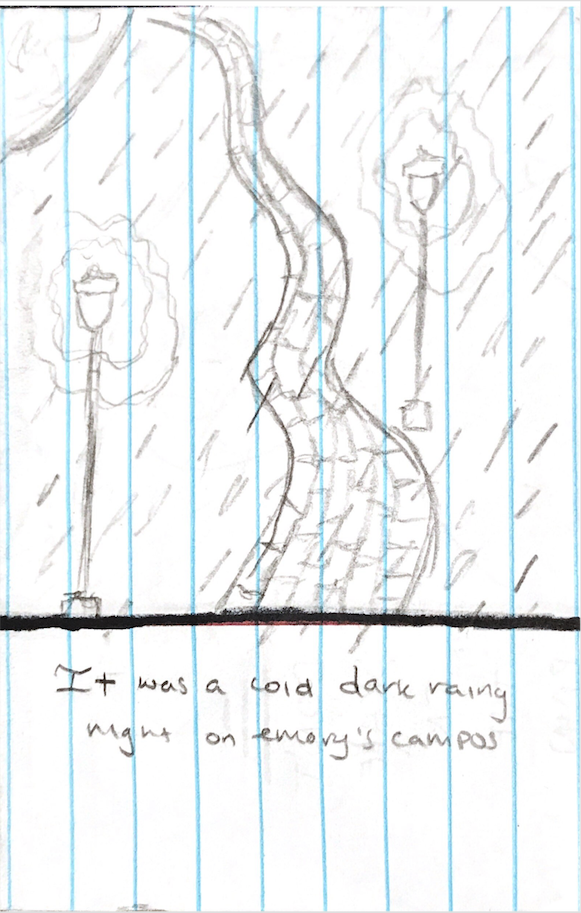
Think of the front cover of that tiny booklet as your first panel and draw the initial image and words for your story. You don’t have a lot of room to hook your reader, and you have to compel her to unfold to section 2. So make it good.
Then open that booklet and draw the second panel on that space that is twice the size. You’ve got a little more space — use it wisely. Fold it open again and draw the third panel on the space that is doubled again. Write something that earns the space. Give the reader enough they they want to flip to the next part. And again for the fourth panel. You should try to not only use the space, but to also ramp up the excitement in each section. And then again, as the fifth and final panel now takes up one side of an entire page. The largest section should contain not only the largest number of words, but also the most exciting content.
Once your comic is completed, publish it to your site as a post. If you follow the method above to create a five-panel comic, scan each panel and upload it as a series. Feel free to include some pictures of your entire book too.
Write a brief reflection about your writing process for this post. How did you know when you had found the right story for your comic? How difficult was it to tell a true story in a brief comic? What were the most important choices you made along the way of creating your comic?