The Secret Language of Comics: Visual Thinking and Writing

A Squeaky New Update

My About Me page just got a fresh new coat of paint, so I’d recommend heading on over there if you want to spot this squeaky swordsman among the colorful new collages.

A lovely mouse musketeer provided from https://www.flickr.com/photos/27640054@N08/4527191830

When reworking my literacy narrative, I wanted to create visuals which grabbed readers’ attentions by being bright, bold, and, if I may be so bold, bemusing. Yet there was one small obstacle in my way: the fact that I am not the best of drawers, and cannot convey with a mere pencil and paper my ludicrous ideas sprung from my peculiar imagination. As such, I intermixed my simple stick-figure sketches with several “comic collages,” which I created by throwing a bunch of free-to-use internet images together. Making a digital footprint requires both eye-catching spectacles and a unique identity, and hopefully my use of silly sketches and ridiculous photo-mashups provides an interesting means of telling my story.

An example of an “explosive” collage

While these collages may seem to be mostly haphazard mashes that took little thought towards staging and framing, I actually did a good bit of planning these out before sitting down at the computer to edit. For instance, all moments of me making positive progress towards my goal of enjoying some books show me moving visually from the left to the right. Meanwhile, whenever some trouble strikes and I lose some love for reading, the agent of detriment or I move right to left. Even though none of my images appear side by side one another, I still wanted the momentum of progress and regression to be consistent throughout the comic.

The old me was quite the harsh critic.

I kept a couple of the images that, when reviewed by my peers in class, garnered favorable reviews and were more easy to understand. One of those, the “Stream of Consciousness” sketch, was run through a photo-editor effect to give a dreamy, watery flow that fits with the subject. This wasn’t something I planned to do beforehand, but rather I stumbled across the effect while cropping it and decided it would serve my story well.

Jewel is indubitably the best character of As I Lay Dying. For all the Darl fans, I’m sorry.

One of the cool aspects of this whole “comic collage” method is how it forces you to be somewhat adaptable towards your original artistic vision. Multiple times throughout this narrative’s creation, I would search for images online to fulfill whatever ideas I had in my head only to find out that no such image exists (at least among those of the public domain). As such, I’d have to select one which, while not my first choice, would either work just as well or even better. For instance, that little clay mouse from earlier was stumbled upon when I couldn’t find a quality non-copyrighted image of the film adaptation of Despereaux, and quite frankly, the clay one is funnier to look at and much more adorable.

Zoom!

Putting these collages together are almost like assembling the pieces of a puzzle, trying to find the right images to work in each panel, a lengthy process in attempting to create the best version possible. Admittedly, it does take a good bit of time, and sometimes a simple drawing would suffice, but I’d like to think the clarity and color gained make it worth the struggle.

The struggle

All in all, I’m very pleased with my colorful comic collages, for they help my life stuff story come to life! And the pun in that previous sentence was most definitely intended.

A Long List of So Many Sources for My Comic Collages:

http://clipart-library.com/clip-art/sign-transparent-background-1.htm

http://pngimg.com/download/2112

https://publicdomainvectors.org/en/free-clipart/Cartoon-thought-bubble-vector-image/7276.html

https://pixabay.com/illustrations/lightning-bolt-lightning-bolt-mp-1203953/

https://www.maxpixel.net/Stacked-Book-Stack-Books-Book-Literature-3342628

https://www.needpix.com/photo/86601/stick-man-people-standing-pec-stick-stick-figure-man-person

https://www.needpix.com/photo/93108/walking-hiking-stickman-stick-figure-matchstick-man-man

https://www.pexels.com/photo/construction-wreck-wreckage-395928/

Tales of Desperaux

https://www.needpix.com/photo/56632/biplane-airplane-oldtimer-yellow-fly-pilot-sky-plane

https://pixabay.com/vectors/stickman-stick-figure-matchstick-man-151356/

https://www.needpix.com/photo/download/854542/book-paper-text-textbook-tome-free-vector-graphics-free-pictures-free-photos-free-images

https://www.netclipart.com/isee/wTTbho_nuclear-bomb-blast-png-transparent-background-explosion-png/

Editing was done using the PicsArt app and befunky photo editor.

Reflection: Literacy Narrative Part 2

In essence, the comics version is not much different from the alphabetic version of my literacy narrative. The prompt for the alphabetic essay was to “analyze the key experiences that shaped the way you read and write”, which led to my analytical approach to writing an argumentative essay. Knowing that this comic would be based on the essay, I slightly changed the structure of my literacy narrative after the individual conference and made essay flow in a chronological order – how I read and then wrote in my childhood and how I read and then write as I grow up. This eventually became the overall structure of my four-page comic, and the passage of time works well for natural transitions. My analysis from the essay became a narrative voice keeping the development of my stories. Specific evidence such as personal anecdotes then became the visuals in the comic, supporting the narrative voice like it did in the essay.

However, the change in the medium did shift my focus when telling the stories because more visual thinking was involved:

First of all, now that evidence became visuals, I had to put greater emphasis on the details of the evidence, or I would have nothing to draw but plain sentences. On the first page, I had to think of the actual images on the books which reflected that “visuals and imagination are powerful tools for language learning, especially for Chinese.” And on the second page, I could not merely state that “I would first think of a scene as detailed as possible and turned it into words,” but came up with the actual scenes and words I would write down. Same for page four, I almost re-read Republic to find a suitable dialogue for this comic. It was a hard but meaningful process to consider how all elements could be represented visually.

After that, the decisions of whether individual elements should be demonstrated by the visuals or just stated as words in the boxes were even harder due to my limited artistic skills. For instance, the main scenes of the first page should be my mother teaching me how to read in Chinese in bed before sleep in my early years. Ideally, the passage of time could be implied by the changes in my appearance and size in different panels, but this would cost me a very long time to draw if I am actually able to do so. The main technique I employed on the first page was the choice of frame, making it hard for the same book to bore the audience. And the interactions between my mother and I were represented through words in the bubbles.

Last but not least, I found a lot of fun when thinking about the overall page designs after I had some ideas for the visuals. I utilized the “all-at-onceness” on page three by dividing a book into three panels, demonstrating the immersive experience when I read. The panel designs also have plenty of room for creativity. On page two, I broke the boundaries and directly used bubbles to replace normal panels, a piece of advice from the peer editing session, since the content is about imagination. I imitated the first comics I read in this class, “Adventures in Depression”, on page four to show myself and my thoughts at the same time in each panel. I did a small change by using a dashed line to show how I effectively broke the wall between reality and imagination through immersive reading.

One of the most meaningful things from this class so far is the “go-for-it” mentality towards drawing or other visual arts. Every time I posted an Instagram story after completing a page, I would receive messages doubting if I truly had not drawn anything after middle school. I am very glad that I pushed myself to draw something seriously for the “visual note taking” sketch, and the momentum has not declined. This mentality also helped me searching for other solutions when my ideas really exceed my limits. Photoshop and PowerPoint saved me a lot of troubles and time when I could not realize my ideas by my Apple Pencil.

So far, this assignment is the most time-consuming project this semester, but I really enjoy the process and would enjoy it more if I were to have more time available.

Learning Language REFLECTION

Writing my literacy narrative as a comic made me value the comic form more. I discovered adding illustrations to text imbues a text with much new meaning. The problem became attempting to control what I say with my illustrations. I found myself bargaining with my narrative at length about what medium – pictures, framing, text, etc. – could best convey information from my alphabetic narrative. With so many variables at play, my comic narrative has more depth and information than my alphabetic essay. One macro-level issue I encountered while creating my comic doubting that I was artistically capable enough to accurately communicate my meaning. I still am unsure about this, but I tried to draw/frame my comic to play toward my style of drawing and not craft a story that looks like it was meant to be draw by someone else. One aspect I fear not being communicated through my illustrations is the color. Color is an important element of my story; certain contrast needed to be highlighted. However, as I went to scan my pages, I noticed the highest available resolution grayed-out many of my browns (brown being one of the most important color symbols in the story). I tried two other resolutions and finally had to recolor by hand certain trouble areas. The product still displays a few characters’ skin as grayer than intended, but I think I don’t know what medium would be best suited to achieve that color vibrancy I initially wanted. I considered computer illustrations once I saw how skewed the coloring was when translated from color pencils/white paper to the computer screen, but by that time it was far too late to start from scratch. Besides, I’ve neve illustrated on a computer before – like ever (not even casually) – so I probably wouldn’t know where to start, not to mention the risk of the drawing turning out subpar due to my lack of experience in that medium.

Overall this process was quite enjoyable. The silver lining of it being so time consuming was I got to justify spending hours upon hours just doodling and coloring which was relaxing. Since, I don’t draw often and this project was heavy illustrations, I feel like I honed my specific style of doodling. My characters have a look to them that’s completely unique to me, and I love it. I love the way my characters look, I love what I discovered about how to make them look even better during this process, and I love how distinctly me it all is. My style isn’t technical or particularly realistic, but it somehow just works. Honestly, this project brought me confidence in my artistic skills – something I never considered myself remotely talented in at all.

Literacy Narrative Reflection Post: Sawyer Steinmiller

It was a lot more difficult creating my literacy narrative as a comic. I have written so many alphabetic essays in the past, so using the medium of a comic was a different process. My story was a lot different in comic form than in alphabetic text. For my literacy narrative part one, the story had little to no emotion in it- there really wasn’t that much plot to me editing the story, but in comic form, I added lots of comedy. This made the story a lot more down to earth. Before, I saw this as a serious turning point in my writing career. After adding comedy to the story, it seemed more relaxing and lighthearted. Honestly, my analytical process was the exact same, but when revising my alphabetic text, I think I am going to try my best to add comedy in it as well. It works very well for my comic so I might as well try my best to mimic that.

I made a lot of difficult choices when curating my comic. I chose to add comedy, which was not in my alphabetic text. I did this because I knew my artwork or the plot itself were not the most intricate, and I knew I needed something to stand out. Comedy comes pretty naturally to me when I have time to plan out the humor. I really tried to focus on the facial reactions of the characters; putting real emotion into my characters faces is something that could have made the story even more funny. If I had more time, resources or even a professional illustrator, I would have them work on my facial reactions. There were not many aspects of my comic where I had a clear sense of what I was trying to accomplish and I think that I failed at that. I think the only instance where I could have made a change was in the third page where I tried to draw me in my room shrieking nonsense, while my mom listens in confusion through the door. If I were to have more time and skills, I would have made the shot from above so you have a clear view of me and my mom, making both of us the focus instead of just my mom.

I think that this project really helped me with my writing process. Writing this project as a comic has helped me realize what I can change about my alphabetic text in order to make it better. Adding comedy to my essay would do exactly what I am telling the reader to do in my comic- it would give it my voice!

Reflection Post: Literacy Narrative Comic

My comic is an autobiography that highlights the major changes in my life that influenced and defined my reading and writing habits. In this comic, I wanted to clearly convey how my experiences with reading and writing drastically changed as a result of the change of environments within my life. To do so, I adopted more of a traditional narrative style where the narrator, which is myself, tells the story with the aid of the images in the panels. Due to this, one may notice that there is very little dialogue between the characters depicted in the comic but rather the story is carried along by the text either found below or above the images—the voice of the narrator. 

As mentioned previously, in this comic I attempted to highlight the change in my attitude and outlook on reading and writing due to various experiences within my life. I believe that this emphasis was much more present in my visual comic than in my original alphabetic text. Once the visual aspect was added, it allowed for easier story-telling and the role of envisioning now fell on myself as the illustrator rather than the reader. As the illustrator, I was now suddenly forced to think about what I want the reader to see and then place that on the page as a drawing to the best of my ability. Not only that, but my thinking process was different as well as I started to invest more thought into what I specifically wanted to say and show rather than the general story that I originally gave in my alphabetic text. The transformation of my literacy narrative from plain alphabetic text to a comic filled with images as well as text gave rise to an extra layer of depth and content which ultimately bettered the story in my opinion. 

Creating this literacy narrative comic allowed for the use of various modes of composing text, namely written, visual, and digital. Because of this, I was forced to step outside of my comfort zone to be able to utilize these differing techniques in writing. Additionally, various techniques and ideas seen in comics which we have read this semester have been used in my comic. For example, the varying perspectives seen in my comic was inspired by panels seen in Stitches and Spinning. This comic also had several different versions which took multiple drafts and rereading to finish showing its process of creation, and critique received from others was also taken into consideration. Lastly, as shown throughout my comic, visual thinking strategies were used as I created each panel. I constantly questioned whether the images and text in each panel properly served its purpose and flowed into the next panel. 

The creation of my Literacy Narrative Comic came around in a rather difficult manner. This is mainly because of the time I spent on the visual aspect of the comic. After drawing each panel out to the point where I wanted it, I went back to detail and shade each image to give it more of an effect when the reader views it. Still, my ideal vision for my comic could not be realized due to time constraints as well as a lack of skill on my part. If I was given more time and a professional illustrator, I would have liked to make the visuals less cartoon-like in order to correspond with the slow and semi-serious tone I was trying to accomplish with the narration. Additionally, I would have included a couple more pages to get even more detailed into how exactly my reading and writing habits changed due to moving.

Literacy Narrative Comic Reflection

Now that you’ve completed your Literacy Narrative Comic, publish a reflective blog post of about 500 words about the writing process, paying special attention to how the work you have done has helped you to meet the Learning Outcomes for this class. That post should link to the page with your literacy comic.

Some other questions you might respond to: How was it different to write your literacy narrative as a comic? How did you think differently once the visual component was added? How did that help you to see the story you were trying to tell in different terms? Was your analytical thinking process any different? How have your thoughts about your alphabetic literacy narrative changed in the process of transforming it into a comic?

I’d also like you to discuss choices you made in creating your comic and to explain why you chose the way you did. Especially if there’s something you were really trying to do in your comic which you felt you couldn’t realize as perfectly as you would if you had a lot more time, more resources, or if you could have hired an illustrator to turn your vision into exactly what you wanted. If there are aspects of your comic where you have a clear sense of what you were trying to accomplish and how you would have done so if some things were different, then explain that in your reflection. Doing so allows you to demonstrate that you have the knowledge you need about this sort of writing even if you have not yet developed all the skills necessary to make that knowledge visible in the final artifact you’ve produced

A Reflection About A Poem About Poetry

I really enjoyed creating this comic because it allowed me to illustrate a story very personal to the way I write today. By depicting the overall concept of my Literacy Narrative 1, I was able to look at it from another perspective that to me was more engaging. In my Literacy Narrative 2, A Poem About Poetry, I look at my journey from not writing anything and disliking my English assignments to sharing my poetry on public platforms. The feedback that I got on our rough draft day was very positive and helpful in creating my final draft. My peers suggested that I really bring the imagery to life as well as find a way to enhance the flow of the comic.

On page 2 I have the phrase “beautiful poetry” going into the characters ear from outside the panel. This panel signified how I would watch poetry but never to write it. I decided to bridge the panels together by creating a loop. On page 3, in the last panel I’m the one creating the “beautiful poetry” that will hopefully be going to people’s ears.

Literacy Narrative Reflection

This week I submitted my final Literacy Narrative comic. Last week, during peer review, I received comments telling me to focus more on the dichotomy between Math and English. As a result, I changed my final page to include an award in English, revealing how I overcame my struggles in English class. I also received feedback telling me to utilize the frames to depict sudden changes in mood and tone. As a result I included panels that were zoomed in on characters faces.

How Satisfied Am I With Myself?

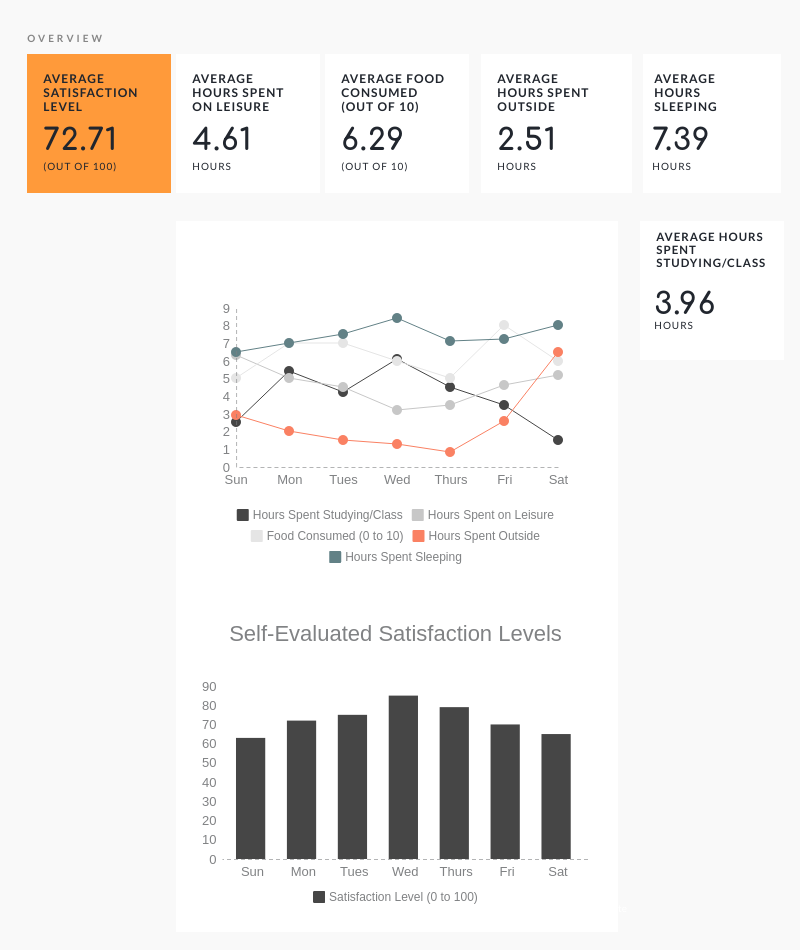
For a week, I tracked various categories that I believe ultimately play a factor in my amount of satisfaction with myself at the end of the day. These categories covered various areas throughout my day such as my work, food intake, leisure, and sleep. While there are many aspects of the day, sometimes very specific aspects, that can affect my satisfaction with myself at the end of the day, these categories were chosen to give a more general outlook at how my satisfaction is affected by my overall day. By doing so, I can analyze the data and draw out possible connections between my satisfaction and the various categories.

I decided to use a line graph to represent the categories as it’s simple way to view multiple data set and easily point out interesting patterns, similarities, or differences, between the data. According to the visualization, I feel more satisfied with myself generally when I have spent more time doing work or studying and less time on leisure, or time outside. As expected, my satisfaction levels correspond directly with the amount of work that I am able to get done and somewhat indirectly with leisurely activities. Another interesting observation is that my satisfaction levels also seemed to correspond to the amount of sleep that I got. The more time I spent sleeping, the more I feel satisfied at the end of the day.

I’m confident that if I was to continue this project as it is into the future, the results will more or less stay the same. In order to look more in depth, I would try to find a way to observe more specific aspects of my life and how they affect my satisfaction. This project is indeed a valuable tool for self analysis as it allows one to be able to draw conclusions not solely based off of one’s opinions of themselves but rather by their actual behavior and habits.

Trinity in English 2019-11-11 03:20:49

Question: Does my external self or internal self dictate my level of confidence?

To answer my question, I chose to track my level of satisfaction with both aspects of myself. I directly recorded this information in a journal, rating each category on a scale from 1-10 (10 being highest satisfaction). For quantifying satisfaction with my physical self, I considered the following: how much I liked my outfit for that day, how I felt about my skin, how much time and effort I put into caring for my physical well-being. For tracking satisfaction with my productivity I paid attention to the following: time spent doing activities I enjoy (writing, dancing), level of focus/energy put said activities, and improvement. I chose to draw bar graphs as my visualization because it was easiest for me to understand. I’m not great with graphs and I’m especially tired of excel right now (blame bio lab). Hand drawing a qualitative graph with colored pencils kept this week’s Sunday Sketch feeling more artistic than analytical.

I expected to see direct proportionality between one category and my level of confidence for the day when analyzing my data. That’s not what I found. Instead, my level of confidence regularly split the difference between appearance and performance. So, the data answered my question indirectly; I receive confidence from difference inputs – where one aspect of my life wains in satisfaction, another can support my self-esteem. Overall, the outcome of this exercise served as a testament to balance – not placing too much stock in one aspect of life. Two data points did not demonstrate a balance between external and internal satisfaction: Saturday and Sunday’s confidence levels. One aspect was especially low on each of these days. These low-rated aspects seem to weigh down my overall confidence.

css.php