The Secret Language of Comics: Visual Thinking and Writing

Eye Drew A Diagram!

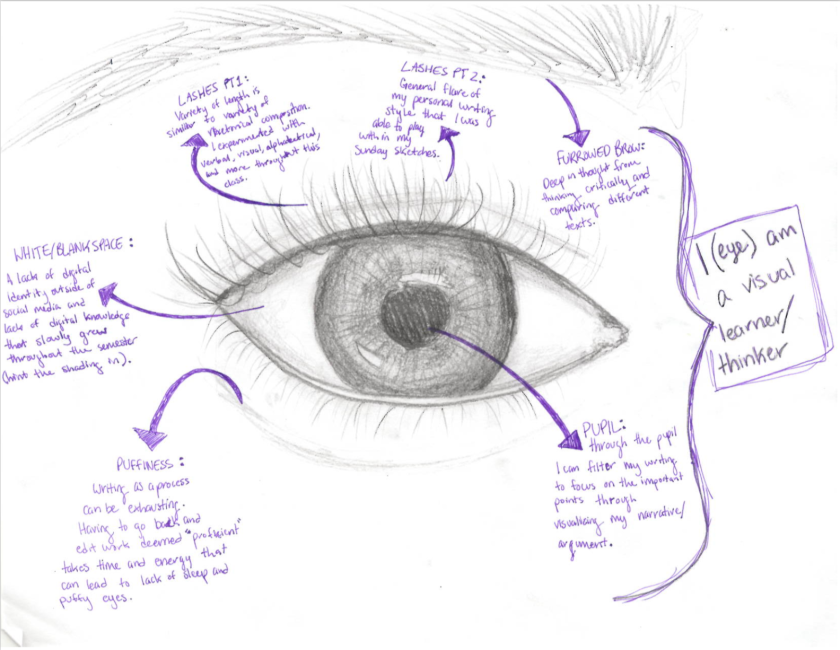
Introductory side note: I want to start this off by saying drawing this eye brought me right back to eighth grade. There was a phase in my life (yes I was one of those girls) where all I would do during class was sketch eyes. Slowly the subject matter changed to clothing…anyway, it felt familiar and silly and I wanted to share that.

On a more serious note, I thought an eye would encapsulate the most important thing I learned in this English class: I am a visual thinker and learner. I always knew I was good at memorizing visuals, but when we talked about the benefits of thinking visually as a part of the writing process, I wasn’t just skeptical, I brushed it right off thinking I knew that style of learning wasn’t for me. I was wrong. Drawing out my literacy narrative was immensely helpful in refocusing the story on what was important in my journey as a reader and writer. I was unable to do that in my alphabetic version when I attempted to edit the paper before drawing the comic. I am not sure if others had the same eye-opening experience as me, but I hope they did because that “ah hah!” feeling of understanding my brain a little better was so satisfying everyone should get to feel that. In my sketch, I labelled the different parts of the eye pertaining to which learning outcome they agreed with the most. The most important part was the diagram itself being an eye because of the sheer impact that visual images, thinking, learning, and tools have had on my experience in this class.

Reflection Post for Literacy Narrative Part Three

Revised Literacy Narrative found here.

In this project, I was able to create and tell a story digitally, visually, and alphabetically. These various modes each came with their own intricacies that I needed to accommodate for. Because of this, the beauty of each mode is able to be shown as one notices the comparisons and contrasts between them. Critical thinking was also an important aspect as I thought about what I wanted to truly say and formed that into cohesive text. This critical thinking process allowed me to turn what at first looked like nothing to me, into a full essay that is able to describe my experiences throughout my life. Additionally, this project has further proven that writing is a process as I was able to revise, get feedback, and make changes to continually better my work. In both the comic and the alphabetic texts, the importance of drafts and constant revision were shown through the results of peer editing and discussions with our teacher.

After creating my comic, it felt like I had a clearer view of what I wanted to say in my alphabetic text. Turning my literacy narrative into a comic forced me to ponder what specifically had an impact on my reading and writing habits and placed more graphic images in my mind of what those experiences were as I illustrated them in my work. In my original draft, it seemed like I was very general and vague in explaining what those experiences were so once revisiting it, I knew that I had to explain them in a manner that was vivid and clear in order to create a successful comic. I was able to focus in on the reasoning behind why my reading and writing habits developed the way they did as I looked at my past with an fixed objective in mind rather than simply looking for a general outlook of it.

As I revised my narrative, the story that I wished to tell was already somewhat clear to me in my mind. I wanted to focus mainly on how my experiences in a different country had the largest impact on my reading and writing. In contrast to the first time when I was writing, I had specific points that I wanted to pinpoint and then further explain and this is changed the way I viewed my story. Now, my story clearly conveys what my biggest influences were and particularly how they influenced me.

Staying Away from the Fight

IMG_0237

I got the inspiration from my favorite Finance Meme Instagram account and decided to use that topic for this Sunday Sketch assignment. The movie scene from the recent Star War: The Mandalorian depicted a bounty hunter and a protector in a fierce fight while the baby Yoda, the bounty target, stood aside watching them peacefully and sipping soup. The baby Yoda who might be the child of big Yoda, the late Jedi Master, went viral online and became a major meme material.

Sketch 11

The scene itself is not of much significance and easy to recreate. It is just because I really like the Star War series, and the memes are so funny that I decided to recreate it.


Assignment Link: https://eng181f19.davidmorgen.org/assignments/sketches/sketch-11-recreate-a-movie-scene/

Unpacking ENG 181:

For my final Sunday Sketch I decided to pay homage to one of our earlier sunday sketches; “What’s In Your Bag?” Where I dissected my school bag and gave a discription of each item. I thought of this sketch when creating this assignment because this English class was very much like a bag containing various elements and items. The two biggest components of the bag were the books we read along with the website we created. This illustration is a reflection of how our class time mainly focused on these two aspects. And the materials we covered that contributed to helping us achieve the outcomes of the course. I also included the outside texts that we used to analyze the comics. I identified these the “Accessories” of the pack because we didn’t necessarily need them but they became very useful throughout the semester. All of the items in the bag were essential to my comprehension and understanding of the Learning Outcomes.

A Recipe for…Disaster?

A diagram drawn by Dean

Having “interesting introduction” as the first layer of my sandwich is putting a whole lot of pressure on this first sentence. Oh well. Sometimes you’ve got to cook not by the book.

I made this diagram based off the National Archives Cocktail Construction Chart, and while I obviously don’t follow this chart to write all my posts, and as my introduction illustrates, I often don’t abide to all of its aspects, I thought this was a pithy way to present my general format. I guess the movie magic is broken now; maybe I’ll switch it up a bit and try something a bit unexpected and–

Final Literacy Narrative Reflection

This week I submitted my final Literacy Narrative in which I discussed key experiences in my life that shaped the way I read and I write. This is a reflection on that assignment.

  1. How has the entire literacy narrative project helped you to meet the Learning Outcomes for this class?
  • Rhetorical Composition: 
    • Through preparing a literacy narrative in multiple forms of writing (alphabetic text and comic form), I was able to better understand how to express myself in a way that is clear to my audience. In each step of the literacy narrative, I grew more and more focused. In part 1, I wrote about 4 or 5 different events, in part 2, I depicted only 3 major events, and in part 3 I spent time delving into 2 major events in order to form a coherent argument.
  • Critical Thinking and Reading Resulting in Writing
    • After creating part 2 of this assignment, I had the unique opportunity to receive feedback from my peers in class. I incorporated many of their suggestions into my revision while maintaining my original thought.
  • Writing as Process
    • In many of my high school classes, I would work on class essays in one format. Although I would spend a lot of time on them, I now feel that I could improve upon them. That is because this class has taught me the importance of writing in different forms. Turning the literacy narrative into a comic before my writing my final version helped me think in ways that I otherwise would not have. Turning my alphabetic text into a comic helped me identify the most important parts of the story and explain what I previously did not realize that I needed to explain. 
  • Visual Thinking
    • I enjoyed assembling my own visual representation of my literacy narrative for part 2 of the assignment. It was interesting to already have an alphabetic version of the comic prepared before creating it. I was surprised by how different my visual representation was from my alphabetic text. 
  1. How was it to return to the alphabetic literacy narrative after having created your comic? How did you think differently after having worked in the visual medium and now returning to a text narrative?
  • After working in the digital medium, I gained a greater sense of what the importance of my story is. Once I realized that it was ok to stray away from explaining events in depth and instead focusing on how the events affected me, my literacy narrative improved significantly. Turning this essay into a comic allowed me to see what my reader would be imagining and helped me create a more compelling story. 
  1. How do you see the story you are trying to tell in different terms now? Was your analytical thinking process any different?3. 
  • The story began as a journey through all of my experiences as a reader and writer. In a sense, it was a written-out version of a timeline. After turning it into a comic, it became more of a bildungsroman focused on one main event and the aftermath of that event.

Words Inspired by Images

Having created a comic before returning to my alphabetic narrative was truly helpful. There are two major changes in my Literacy Narrative Part 3 essay, both inspired by my comic. First, I was able to use more vivid language in the new version to make my narrative more engaging. Although this seems to be the trend of all revising process, having converted the text narrative in the form of a visual medium beforehand definitely makes the revision on language easier. For example, in my original version of the essay, I wrote, “whenever I felt like letting my thought fly away, it always ended up hitting the walls they built.” When visualizing this part of the narrative through comic, I chose to depict a bird locked up in a cage to symbolize my helplessness in that situation. This image, then, surprisingly inspired me to reframe the sentence in a more engaging way: “whenever my thoughts struggled to break free from the iron chains, hopping and flapping desperately to find a way out, they always ended up hitting the towering walls of rules, wounded.” In conclusion, the comic allowed me to actually envision my narrative and through the imagery, I was able to further polish my wording. The other major revision is on the overall content of my narrative. During the peer review process, I realized that each of my peers gave very different interpretations of the theme of my narrative, which led me to reflect on how to make my theme clearer in the upcoming revision. Reading over my comic again, I found that I needed to emphasize more on my discovery of the power of combining visuals and written texts,  which is the intended overarching theme of both my essay and comic. Therefore, I went back to my alphabetic text and strengthened this idea through reframing sentences for emphasis. I also noticed that the second part of my original essay was a bit unrelated to my theme, so in my revised version, I focus more on portraying how I learnt to incorporate images and words to overcome difficulties I met when reading and writing. It really surprised me that viewing visual mediums like comics seemed to be a quite “sensory” process, yet it actually contributed to the overall logic and structure of my text narrative.

The literacy narrative assignment undoubtedly helped me meet several aspects of the learning outcomes of this course. Having revised the essay three times (including the comic creation process), I learnt that writing is an ongoing process that every time we go back to the text, something new would come up and be changed. The repeated editing is, indeed, the indispensable process of creating a successful and thought-through essay. Moreover, as aforementioned, I was inspired by visual elements to polish the language and identity tensions of my narrative. And this process of jumping back and forth between visuals and alphabetic text and generating new ideas from it is exactly the demonstration of visual thinking strategies.

An Updated Literacy Narrative of my Life

Re-visualizing my literacy narrative has been a truly eye opening process for me. My original literacy narrative and this updated version, The Story Behind the Pan and Paper, depict very different aspects of my journey with reading and writing. While creating these drafts, it became clear to me that the story I wished to share with the world had changed immensely. In this new version I decided to dive head first into the true driving forces behind my literacy journey instead of the surface level story in my original. Thus, I was forced to expand my analytical thinking and break down the experiences and memories that eventually drove me to my love for reading and writing. Doing this allowed for a deeper writing process that was, at times nerve-wracking, but ultimately liberating as I was able to share my story and release some of the trauma that I’ve faced in my life.

After working with a visual medium in creating the comic version, this story seemed to fully come alive in my mind. It was difficult to draw each image and relive the memories that I was depicting, but it gave me the opportunity to look back at these experiences and what I really felt in those moments. Creating the comic provided me with a deeper understanding of my real story and all the emotions that came with it.

The literacy narrative assignment as a whole has truly challenged me to become a better writer and to look back at some of the most traumatic moments of my life. As for the learning outcomes for this course, I believe completing this project as helped me meet many of them. Writing as a process has been one outcome that I have really come to understand because of this project. My first draft was not my best work, but it allowed me to reflect and think deeper in order to complete my comic and final narrative. Along with this, the comic portion of this assignment forced me to imagine my story visually and compose it in a medium that had been all new to me. Ultimately, the literacy narrative project provided me with great progression as a writer. It has taught me many things about myself and showed me the potential I have for the future. I feel very proud of the work that I have completed and will use what I have learned from this assignment for all of my writing to come.

Are You Really Home Alone?

For this assignment I knew I wanted to do a holiday movie as soon as my roommate brought back a tree for our room so we could “feel the Christmas magic”. In order to decide on what to do, I googled “Christmas tree movies” and once this scene from Home Alone came up, I knew it was what I wanted to recreate. Logistically, the greatest struggle was finding somewhere where I could be on the other side of a “window” because there was no way to be on the other side of our dorm window. Working with my roommate, who is featured as Kevin in the picture, we brought the tree out into a study room where I would be able to peer through the study room door. One of the hardest parts of this process was having the different portions of the movie scene to scale, since our tree is much smaller than the one use in the film. We did our best to keep the wardrobes the same, but I did have to substitute a bucket hat for a beanie. I chose my roommate to be Kevin because of how she embodies child-like joy, especially around Christmas, so although her facial expression isn’t the same as Kevin’s I was happy how it turned out because it captured both her spirit and the general “Christmas magic” in the air that Home Alone portrays.

Image Source: https://metro.co.uk/2017/12/20/why-i-have-to-watch-home-alone-every-christmas-7037310/

Birth of A Poet Reflection

For my third and final Literacy Narrative I revised my story of how poetry shaped me as a writer. All the revisions I’ve made to the initial draft can be surmised in the simple changing of the title from “Literacy Narrative 1” to the “The Birth of A Poet.” This rebranding of my work reflects how my perception of the assignment became more personal as I progressed over the course of this semester.

Initially I didn’t understand the purpose behind writing a story about how I became a writer. It wasn’t until after creating my comic that I understood why this assignment was so integral to my journey as a writer at Emory. These literacy narratives weren’t simply about recounting moments that made me write a certain way. They were about making me understand as a writer and critical thinker, why these moments made my writing the way it is. Upon understanding this why, I can confidently say that all of my writing assignments have become more enjoyable.

Before taking this class I did not enjoy extended writing assignments. I spoke of this discontent in my first Literacy Narrative. I also stated that I seperated the idea of writing assignment for class from creating poetry. I was very invested in poetry because “it gave me a voice and I began writing poems about people, places, politics and social justice issues I found compelling.” This was the why behind my writing.

Once I realized that not only poetry, but writing in general, allowed me to have a voice, I became more invested in my writing. Although his realization may seem obvious to some, it took a very long process for me to come to this conclusion. Ultimately it was the comic in “Literacy Narrative II” that I created which gave me this new perspective. I decided to structure the comic in the form of a poem and capture the main ideas of the alphabetic texts. To me, poetry has always been about capturing the bigger picture. In retelling the overaching concept of my alphabetic narrative in the form of a poem and illustrations I realized that poetry, drawing, and writing weren’t so different after all.

In returning to the alphabetic text I made sure that it captured the main idea of why writing was important to me instead of just recounting an boring old story. The process of creating a comic highlighted the main ideas of my first Literacy Narrative and in my revisions I believe I was able to use those main ideas to increase the clarity of my alphabetic text.

As for the Learning Outcomes I explored through the process of my Literacy Narratives, there are two primary outcomes that come to mind. The outcome of “ Rhetorical Composition” was most exemplified in the process of creating these narratives. As I stated before, it wasn’t until after I “composed texts in multiple genres,” that I was able to understand the importance of the assignment. Secondly, “Writing as Process” also helped me achieve this understanding because it wasn’t until my draft was peer edited and revised that I was able to thoroughly reflect on it. I really feel as though my comic and Literacy Narrative are “successful texts” due to the multiple revsions they underwent during the process of their publication.
css.php