The Secret Language of Comics: Visual Thinking and Writing

What I Learned from “Learning Language”

The entire literacy narrative project helped me view my writing as an ever-evolving process. The process of writing, drawing, and writing again necessitated re-imagining my narrative with every new rendering. Thus, I was given the opportunity to develop my original idea more than I originally thought was possible. Returning to the alphabet narrative from having created a comic was much easier than writing from scratch. Drawing the comic after the original alphabet essay added more depth and meaning to my essay that I could pull from for the redraft. My narrative began as what I thought was a story about my anxieties around English. Upon revisiting, I realized just how superficial my first draft was – how it failed to address its subtext strongly enough to be clearly understood and deeply felt. My hesitance and need to convey a story clearly struck a balance in my comic; I could represent what was hard to say without using words, and I could spell out the ideas that would guide interpreting my illustrations. In the draft of my alphabetic narrative I took all the ideas from both drawings and text to tell my story again, this time with a bolder voice. For my literacy narrative, the three parts were practice in exacting and amplifying my writing voice, riding it of fear of saying exactly what I want to say.

Alphabetic? Forget it!

I recently added an alphabetic version of my life stuff (which originally came with some, erm, “explosive” imagery). All in all, I think it’s not a bad piece of work, but it can’t hold much of a candle to those pictures. It’s made me realize the importance of visuals to get ideas across, especially on the internet. An eye-catching element is essential to most any post; it’s what grabs attention. Moreover, that quote — the one about a picture compared to a thousand words — well, I believe it is true. Words can’t draw conclusions as tightly and efficiently as a mournful stick-figure; pictures keep the punchline succinct and provide a cadence between paragraphs. I know that sounds pretentiously stupid, but I hope there’s some semblance of a point in that statement.

Going back to pure text walls just leaves me running into rambles, running into “walls,” so to speak. When you are required to add visual elements, you’re more able to see the bigger whole and where each of the pieces fit in that puzzle. Words run together and into themselves when they’re no organizational barriers to place in between. Looking back on my life stuff, I’ve come to see it as a set of “moments” around which words bridge the gaps; it’s something you can’t tell and can only show…

I don’t know. This whole process has been rather existential, and I feel I’m applying meaning to the mundane, creating analogies for inexplicable instances born out of happenstance. Aren’t we all born out of happenstance? Ain’t that existential? Is this not rambling?

Pictures, I think, helped make my story more positive. Something’s cathartic about placing a stick-figure where you want to be. But maybe I’m not actually there, on that road, walking towards Adulthood. I ought to be, or more importantly, I ought to know just where I am. I can’t help but feel I’m rewriting history with those pictures. But I know they’re honest; what you think and know are often two different things I’ve found.

If this reflection has proved anything, it’s this: words are murky muddle-uppers, and pictures are crisp, clean, and clear. There’s so much happening in an image, but there’s a certainty to ambivalence, that the associations and inferences are uncertain, and therefore — because they could mean most anything — more likely to be true. Words are ambivalent to, I guess, but it’s hard not to see them as certain when they’re dried upon a line or etched into your computer screen.

Socrates said it best: “I know that I know nothing.”

Here’s an emoticon, a mix between words and pictures: ¯\_(ツ)_/¯ It’s the best I’ve got at the moment, and I hope it speaks better than I.

Breaking News: I’m a Visual Thinker

The process of creating all three literacy narratives touched on all of the learning outcomes. I accessed the rhetorical composition learning outcome by writing visually and alphabetically. After each narrative was published, I had to think critically about how to improve and focus my story. My narrative is about recognizing writing as a process. By posting three different versions, each with reflections, the project has added six pages to my digital identity. The most meaningful learning outcome I met was in visual thinking. Thinking visually–somewhat ironically–completely changed how I view my writing and thinking process. After writing my first literacy narrative, I had some ideas for what needed improvement and tried to revise the essay before I would have to draw it in comic form. While editing it to shift the focus slightly from outside approval to asking for help, I got stuck and didn’t know what to do. This forced me to map out my comic in a set of bullet points based on what would be the most important aspects to visualize. In doing this, I realized I had missed two key elements that would eventually tie my new theme together. After completing the comic form of my literacy narrative, editing the alphabetic text was by far easier. I was skeptical that drawing out my narrative would have any noticeable impact on my story, but in fact, it was a tremendous help. Thinking visually is a new and helpful tool I can now rely on to focus my work when I get lost in the revision process.  

The Fugitive

The day before getting this assignment I had just watched The Fugitive, starring Harrison Ford. This movie spoke volumes to me, as it was about a man who was sentenced to death for a crime he did not commit. Ever since hearing an assembly in high school about the “Innocence Project” I always found the topic very interesting. That’s why I found it fitting to use this as my scene to recreate.

Thanksgiving Drama

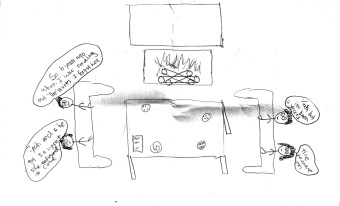
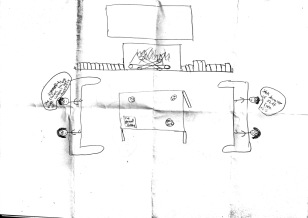
The hardest part of this Sunday sketch was finding the inspiration. I knew I wanted to depict a conversation, however I couldn’t think of anything with significance or true meaning. I left early for thanksgiving break as I had to travel to Alaska, where a majority of my cousins live. I knew I still needed to complete this Sunday Sketch, and as a result continued to look for inspiration. Finally, late on Thursday night I was in the kitchen when I overheard my parents talking with my dads cousin and his wife. They were in the living room talking about one of my relatives who refuses to come to thanksgiving because of an incidence over 5 years ago. It was interesting only being able to use 5 panels however considering the length of the conversion I didn’t have much trouble. I did struggle with making each panel more exciting, considering it was a stationary conversation however I think I did a good job.

Feeding the Homeless

Reflection

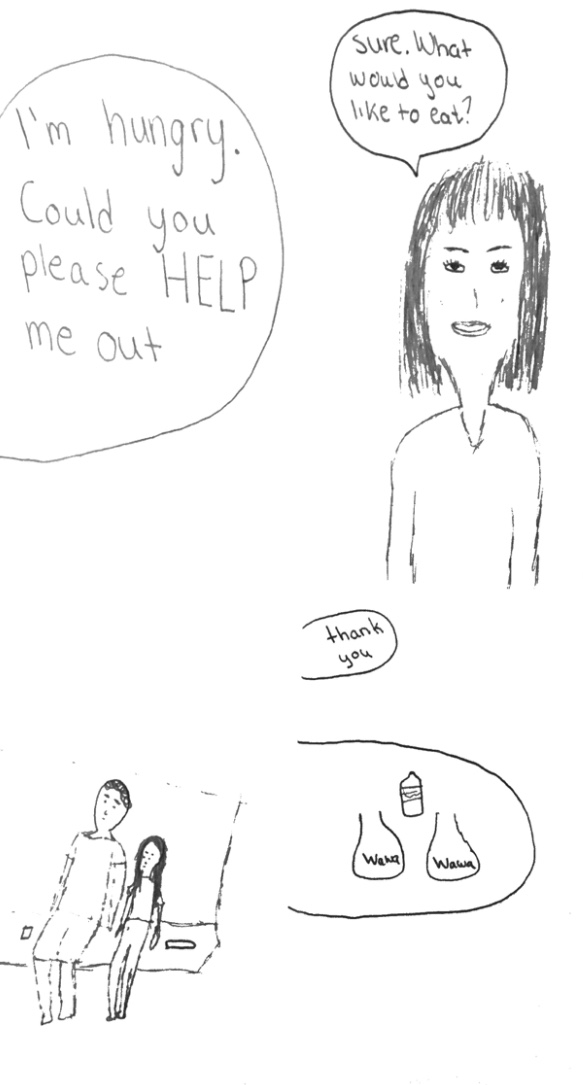
This was an experience that I had less than a week before creating my comic. I had been very conflicted after this experience and wanted to reveal the story in a visual way. I had told this story to a few of my friends then realized that it would be a great idea to make my comic about this. Before drawing the comic, I made a rough draft. I drew out the panels for the first three pages. I had a lot of difficulty deciding what to do with the fourth page of this comic, so I started with the fifth page. For the fifth page, I wrote out a brief description of what I wanted to do with each panel. Then, after much deliberation, I decided to utilize the fourth page as a way to express my conflicted feelings rather than simply depicting the events exactly as they happened.

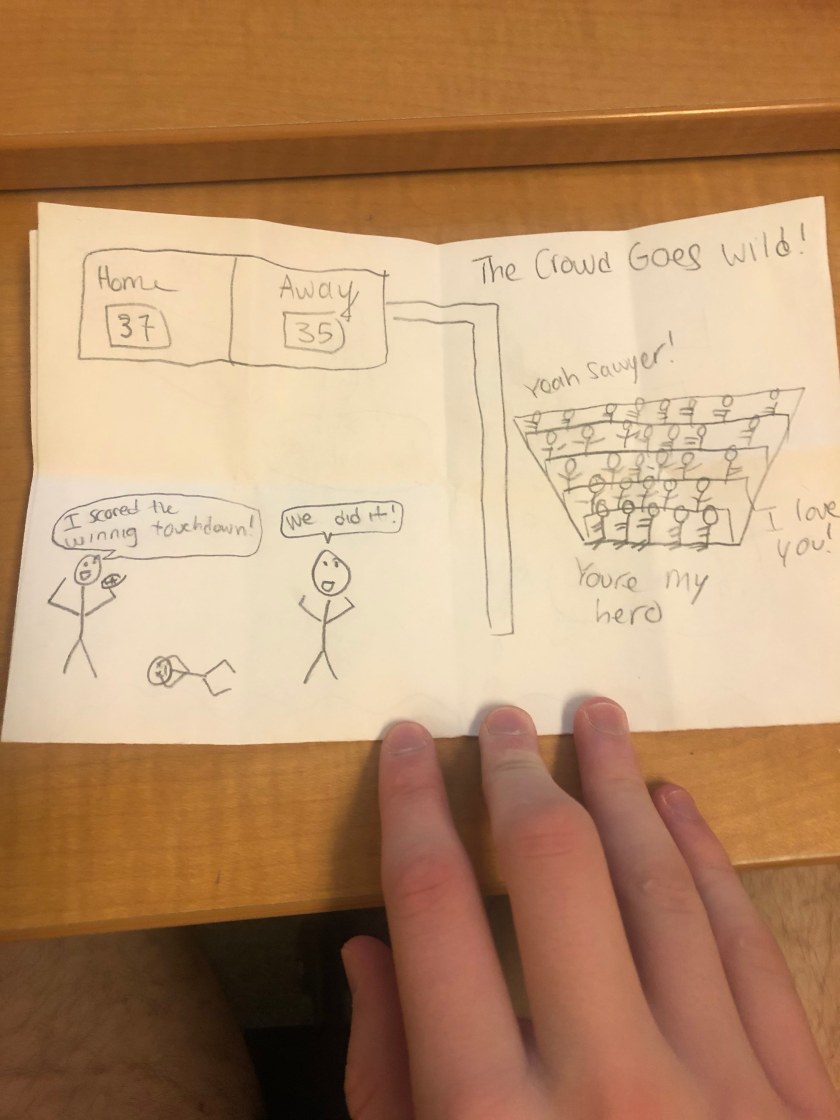
Thanksgiving Football: Sawyer Steinmiller

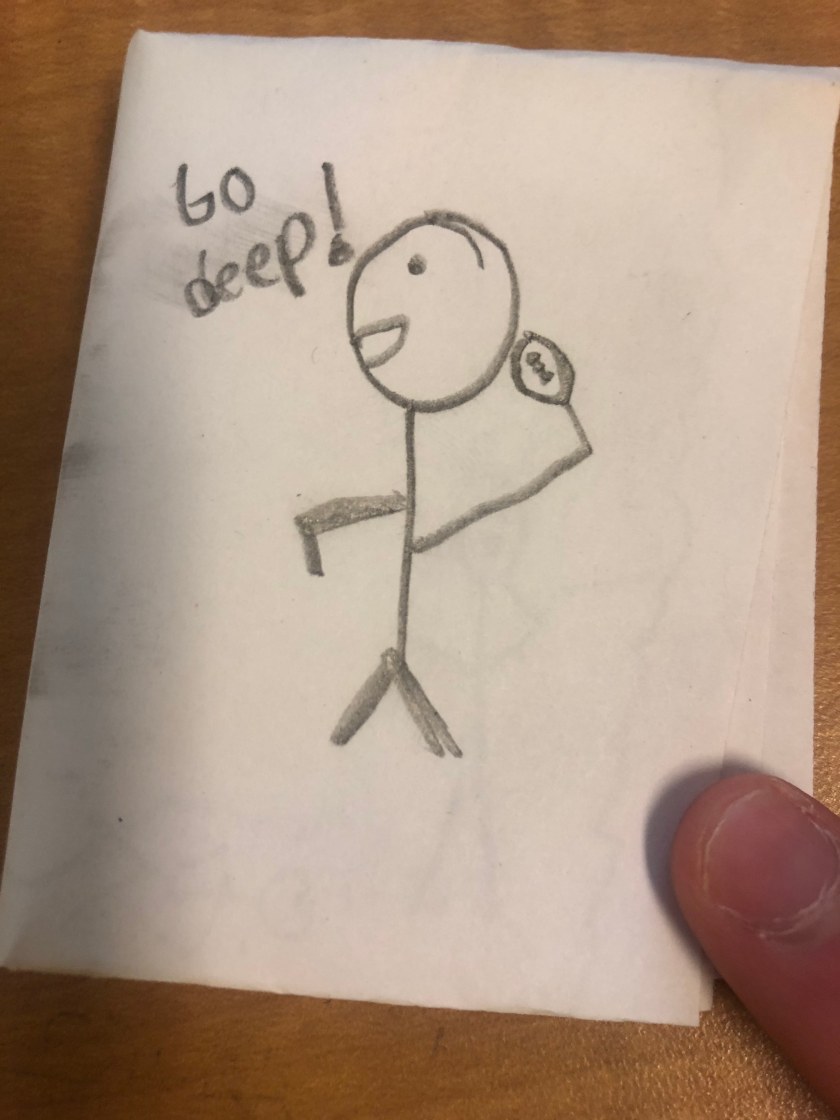
I am going to preface this by saying that I did this assignment late because I left extremely early for Thanksgiving break. I knew that I wanted my comic to be about something that happened on my trip back home. I knew that writing about my Thanksgiving football game would be the best idea because it was just about the only thing that I did besides taking care of family. Honestly, telling the story was not as hard as I thought it would be. This format of a comic was super easy and fun to use. I think the most important choice that I made when making this comic was how I revealed information through the size of the panel. The first couple panels set the scene, showing a football game. The next two panels reveal that its a high stakes play in a high stakes game with the scoreboard and crowd, and the fifth and final panel reveals that the whole scenario is in my mothers head, while she watches me face plant when trying to make a catch.

Here is a link to the rubric!

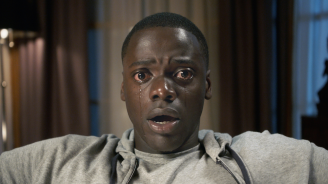
Welcome to the Sunken Place

https://www.looper.com/142537/this-is-how-these-actors-fake-cry-in-movies/

This scene was taken from the movie Get Out and somewhat hard for me to recreate. The main difficulty came from trying to get the expression right and I still never actually did. My pictures always ended up in me either looking like I was yawning or I was very lost which in a way I was when doing this assignment. The only other struggle was the tears because the water dried up way too often so there was a lot of re-applying. Apart from this, I couldn’t find a good and similar background so just ended up using my dorm room and my head always seemed to be tilted a bit. Overall though, this was a pretty fun assignment not only to create but to also see other people’s outcomes as well.

css.php